Abstract
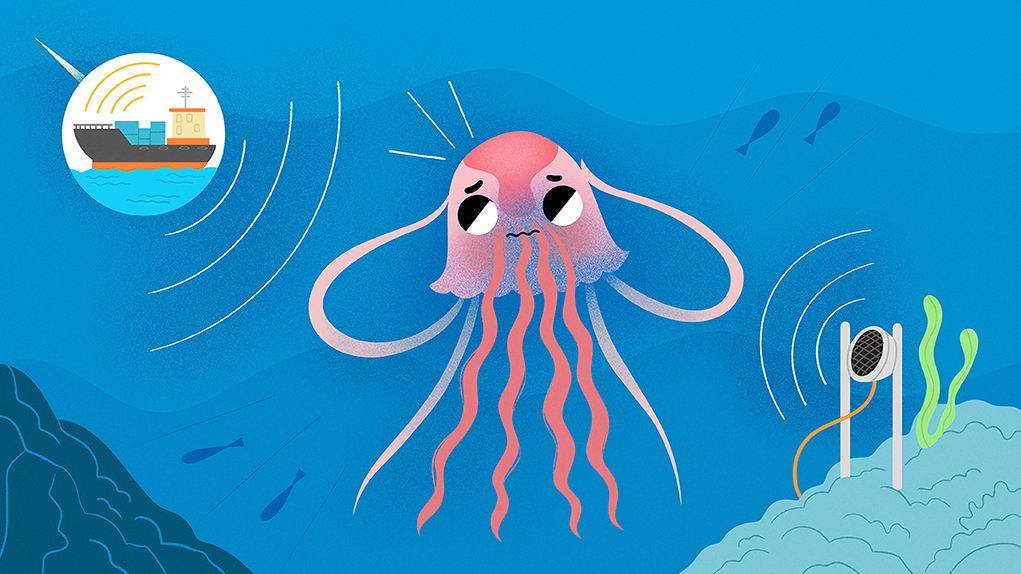
Different types of sounds affect marine animals, including invertebrates (animals without backbones) like crabs and octopuses. Invertebrates play important roles in marine ecosystems, and many of them can make and hear sounds. But what happens when they hear music, or loud human-made noise? Pollution from human activities, such as shipping and construction, can harm these animals. We analyzed published scientific studies to uncover the big picture of how underwater sounds affect invertebrates. This is called a meta-analysis, and it allows us to combine results from many scientific studies to show overall patterns. The types of sounds that have been tested include human-made noise, natural environment sounds, synthetic (computer-made) sounds, and music. Our results show that noise pollution and synthetic sounds can harm invertebrates, and that natural sounds and music can slightly benefit them. By studying how sounds affect invertebrates, scientists hope to find ways to reduce noise pollution and protect ocean ecosystems.
What Makes Sounds Underwater?
Many of us use sounds every day to communicate and understand the world around us. Most animals also use sounds to talk to each other, even underwater animals from giant whales to schools of fish and tiny shrimp. Scientists have spent a lot of time studying the amazing calls and songs of big ocean animals like whales, but the sounds made by smaller underwater creatures are just as important for marine ecosystems.
Some of these small creatures are part of a group called invertebrates. Invertebrates are animals that do not have a backbone—unlike us humans! They can be found everywhere, both on land and in the water. In fact, most animal species on Earth are invertebrates. Examples of marine invertebrates include corals, crabs, jellyfish, octopuses, sea stars, snails, and worms (Figure 1).
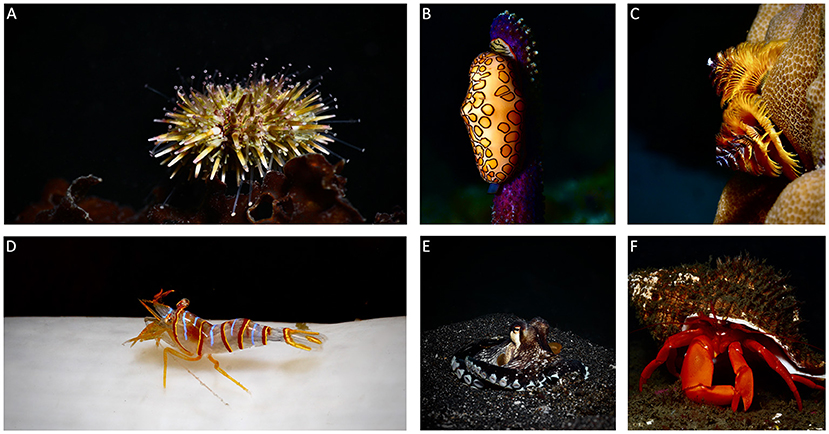
- Figure 1 - Marine invertebrates come in all shapes and sizes, each playing an important role in underwater ecosystems.
- For example: (A) purple sea urchin, (B) flamingo tongue snail, (C) Christmas tree worm, (D) candy-striped shrimp, (E) coconut octopus, and (F) red hermit crab.
Invertebrates are important to study because some of them are food for humans, including shrimp and mussels. Many play key roles in their ecosystems, like corals that build reefs. Scientists have also found that many invertebrates can make and hear sounds in surprising ways. For example, spiny lobsters make sounds by rubbing parts of their shell together. These sounds can help scare off predators such as octopuses [1]. Snapping shrimp are another example—they have one big claw that they can shut so fast that it makes a loud snap! This motion also shoots out a tiny jet of water strong enough to hurt their prey [2]. These loud snaps can be heard all over tropical reefs. However, scientists are finding that human sounds are starting to take over underwater ecosystems.
Noisy Aquatic Ecosystems
The noisiest creatures in almost every ecosystem on Earth are humans! We use huge ships to move goods around the world, build machines to gather resources from the ocean, and constantly put up new buildings. Many of these activities happen underwater or near the coast, so human-made sounds have become a big part of marine soundscapes (the collection of sounds in a specific place; Figure 2) [3].
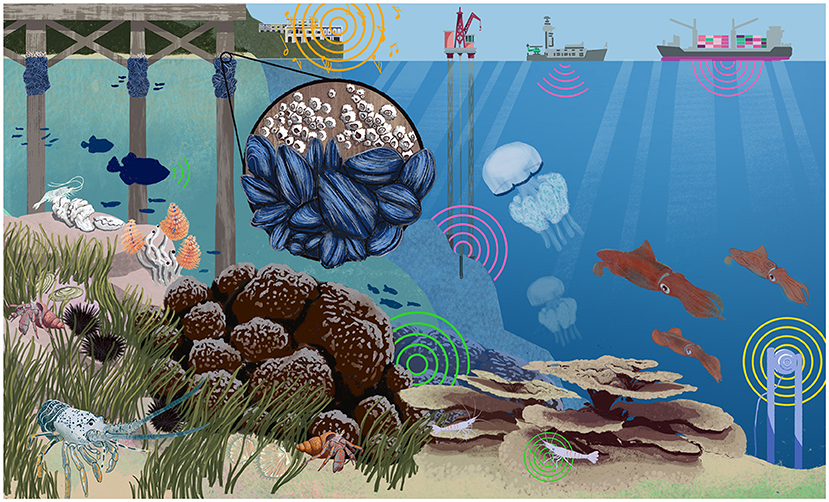
- Figure 2 - The soundscape of a tropical marine ecosystem that is home to many invertebrate species.
- See if you can find barnacles, Christmas tree worms, corals, hermit crabs, jellyfish, oysters, scallops, sea urchins, shrimp, a spiny lobster, and squid. Sounds come from many sources, including human noise (pink) from ships and construction, computer-made sounds (yellow) played through underwater speakers, natural environment sounds (green) from waves and animals on the reef, and music (orange).
Just as plastic trash can pollute the environment, humans can also create noise pollution. This happens because many of the sounds we make are loud, do not carry important information, and can harm animals. But not all sounds are bad. Scientists use computer-made sounds to study how different pitches and loudness affect animals. Also, natural environment sounds, like coral reef soundscapes, can be very helpful to species. For example, baby invertebrates can use these sounds to find a good place to live [4]. Scientists have even experimented with playing classical music to crabs to see how they react [5]!
You might know that marine mammals like whales can hear sounds underwater. Many fishes and invertebrates can, too. Because of this, they can be harmed by noise pollution [3]. Marine invertebrates do not have outer ears like humans, but they can still sense sounds and vibrations using special body parts such as internal structures and tiny sensory hairs on their bodies [3, 6].
Scientists study how invertebrates react to sounds by measuring their responses. These reactions are grouped into two categories: behavior (such as moving or eating) and physiology (growth or health). Experiments can happen in a laboratory tank with underwater speakers or in the invertebrate’s natural home, like a coral reef. Scientists have done many studies about how sounds affect marine invertebrates, but it is hard to understand the big picture just by reading each one. To solve this, we did something called a meta-analysis. A meta-analysis is a big study that combines information from many smaller studies to find overall patterns.
We began by searching for all published studies on underwater sounds and invertebrates, using keywords such as “sound” and “invertebrate”. This gave us over 1,700 articles. After reading each title and abstract, we kept the ones that were about how sound affects invertebrates. We then carefully read each article to see if it had the information we needed, like how many animals were tested and the average (mean) response. The studies included information on 50 different invertebrates and four types of sound: human-made noise (noise pollution), synthetic (computer-made) sounds, natural environment sounds, and music.
Even though noise pollution, computer-generated sounds, and music are all made by humans, they differ in important ways. In our study, human-made noise refers to loud and disruptive sounds from things such as ships, underwater drills, and marine construction. Computer-made sounds are used in experiments to test single pitches, changing pitches, or white noise, which includes many pitches at once (similar to TV static or a waterfall). Music includes more complex and patterned sounds with different pitches and rhythms. In this case, the music was classical pieces such as Mozart. In contrast, natural environment sounds were mostly recordings of coral reefs and sometimes individual animals like fishes.
In the end, 46 studies from 15 countries made it into our final dataset. With these studies, we had 835 measurements of how invertebrates respond to sounds. For each study, we collected three important numbers: the mean response of the animals, the number of animals tested, and how much the response varied. We used these numbers from both the treatment group (where animals were exposed to sound) and the control group (where there was no sound). These values were then used in a formula that helped us calculate the size of the sound’s effect. Doing this for every study allowed us to compare different sound types, and to show overall patterns in the results.
We divided the results into two categories: behavior and physiology. But not all sound types had both kinds of studies. For example, there were no physiology studies on natural environment sounds, and only one study tested how music affects physiology.
How Sounds Affect Marine Invertebrates
Our meta-analysis taught us three main things, shown graphically in Figure 3.
• Human-made noises and synthetic sounds harmed both behavior and physiology. For example, ship noise made crabs worse at hiding from predators, and computer-made sounds damaged the hearing structures of jellyfish.
• Natural environment sounds, like those from coral reefs, slightly helped behavior. Researchers found that baby oysters were more likely to settle when oyster reef sounds were played.
• Music slightly helped physiology by improving the survival and development of free-swimming baby crabs. Scientists think the steady rhythms and vibrations of the music might be calming or help signal when it is time for the crabs to grow up [5].
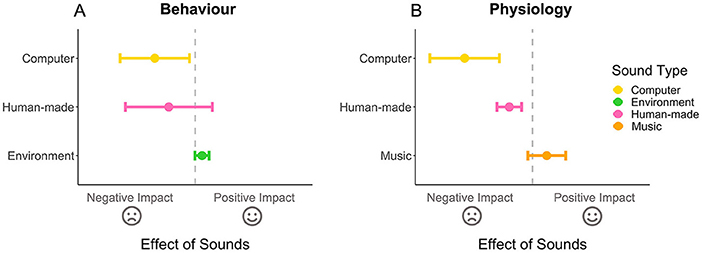
- Figure 3 - How sounds affect invertebrates’ (A) behavior (feeding or hiding) and (B) physiology (growing or breathing).
- The colored dot shows responses to sounds. Lines on either side of each dot show how responses vary between animals. Longer lines mean results were more different between studies, making it harder to determine exact responses. The gray dashed line means “no effect”—suggesting some animals might not respond to certain sounds. Dots to the left of the line show that the sound was harmful. Dots to the right indicate the sound was beneficial. For example, pink dots show that human-made noise usually harms invertebrates.
We also found that sounds affected some types of invertebrate responses more than others. These included the ability to defend against predators (such as how much time animals spent hiding), changes in the natural chemicals in their bodies, their DNA, and their shape and size.
To figure out which animals were most affected by sounds, we combined them into groups of related animals called taxonomic groups. The two groups most impacted by sounds were arthropods, such as crabs and lobsters, and molluscs, including squid and snails. These were also the groups that scientists have studied the most.
What Does All This Mean?
Human activities are creating noise pollution that harms marine animals, including invertebrates. In some places, this noise is so loud that it drowns out natural sounds such as shrimp snapping, fish swimming, and whales singing, which are all important parts of natural underwater soundscapes [3]. Noise pollution makes it harder for invertebrates to escape predators, call out to friends, and find food and good places to live [3, 4, 6]. It can even affect how fast invertebrates grow and the chemicals in their bodies.
It is very important to keep studying how sounds affect marine invertebrates. These studies can even include sounds that might help them. For example, playing recordings of healthy coral reefs can attract baby fishes and invertebrates, which could help reefs recover [4]. And while it might sound funny, playing music could improve the lives of invertebrates raised in tanks for food, like shrimp and crabs [5].
Our study also showed that we need to learn more about invertebrate species from different parts of the world. Some important groups, like sea stars, sea urchins, and sea cucumbers, have not been studied much. Also, there are not many studies from certain areas, like regions near the equator. Understanding how sounds impact invertebrates everywhere can help us create better rules to reduce noise pollution. We hope our research helps people understand the big picture of how sounds influence marine invertebrates, the most common animals on Earth.
Glossary
Invertebrates: ↑ Animals that do not have a backbone. Over 90% of all animal species on earth are invertebrates, ranging in size from microscopic mites to giant squid.
Soundscape: ↑ The collection of sounds in a specific place, considered all at once. For example, a coral reef soundscape might include invertebrate snaps, fish feeding and communicating, and ships passing by.
Noise Pollution: ↑ Loud and unwanted sounds that do not carry important information and can harm animals. Noise pollution is usually created by human activities such as shipping, gathering resources, and building.
Pitch: ↑ How “high” or “low” a sound seems when heard. This is determined by the distance between sound waves, which is commonly referred to as frequency.
Behavior: ↑ The study of how animals act, including how they move, find food, avoid danger, and communicate. Each species has unique behaviors that help them survive in their natural environment.
Physiology: ↑ The study of animal bodies, including how they work on the inside and what influences growth and health. For example, body shape and blood chemistry.
Meta-analysis: ↑ A type of study that combines data from many different studies using statistics. This helps researchers find answers and patterns that might not show up in just one study.
Taxonomic Groups: ↑ A way to classify organisms based on shared features, which allows them to be arranged into levels, such as species, family, or kingdom.
Conflict of Interest
The authors declare that the research was conducted in the absence of any commercial or financial relationships that could be construed as a potential conflict of interest.
Acknowledgments
This research was funded by the Natural Sciences and Engineering Research Council of Canada (NSERC) Canadian Healthy Oceans Network (CHONe II). HD was supported by the NSERC Vanier Canada Graduate Scholarship. HS was supported by the University of Victoria. KM was supported by Fisheries and Oceans Canada’s Ocean and Freshwater Science Contribution Program and the University of Victoria. AL was supported by a graduate fellowship from the School of Forest, Fisheries, and Geomatic Sciences at the University of Florida. FJ was supported by the Liber Ero Foundation and the NSERC Discovery Grant. KC was supported by the Hakai Institute, the Liber Ero Fellowship, and the NSERC Postdoctoral Fellowship.
AI Tool Statement
The author(s) declare that no Gen AI was used in the creation of this manuscript.
Any alternative text (alt text) provided alongside figures in this article has been generated by Frontiers with the support of artificial intelligence and reasonable efforts have been made to ensure accuracy, including review by the authors wherever possible. If you identify any issues, please contact us.
Original Source Article
↑Davies, H. L., Cox, K. D., Murchy, K. A., Shafer, H. M., Looby, A., and Juanes, F. 2024. Marine and freshwater sounds impact invertebrate behavior and physiology: a meta-analysis. Glob. Change. Biol. 30:e17593. doi: 10.1111/gcb.17593
References
[1] ↑ Bouwma, P. E., and Herrnkind, W. F. 2009. Sound production in Caribbean spiny lobster Panulirus argus and its role in escape during predatory attack by Octopus briareus. N. Z. J. Mar. Freshw. Res. 43:3–13. doi: 10.1080/00288330909509977
[2] ↑ Versluis, M., Schmitz, B., Von der Heydt, A., and Lohse, D. 2000. How snapping shrimp snap: through cavitating bubbles. Science 289:2114–7. doi: 10.1126/science.289.5487.2114
[3] ↑ Duarte, C. M., Chapuis, L., Collin, S. P., Costa, D. P., Devassy, R. P., Eguiluz, V. M., et al. 2021. The soundscape of the Anthropocene ocean. Science 271:1–10. doi: 10.1126/science.aba4658
[4] ↑ Williams, B. R., McAfee, D., and Connell, S. D. 2021. Repairing recruitment processes with sound technology to accelerate habitat restoration. Ecol. Appl. 31:e02386. doi: 10.1002/eap.2386
[5] ↑ Ren, Z., Wang, J., Wang, C., Mu, C., Ye, Y., and Shi, C. 2021. Music stimulus has a positive effect on survival and development of the larvae in swimming crab Portunus trituberculatus. J. Oceanol. Limnol. 40:1277–85. doi: 10.1007/s00343-021-1060-7
[6] ↑ Solé, M., Kaifu, K., Mooney, T. A., Nedelec, S. L., Olivier, F., Radford, A. N., et al. 2023. Marine invertebrates and noise. Front. Mar. Sci. 10:1129057. doi: 10.3389/fmars.2023.1129057