Abstract
Going to school is an important part of childhood. School is where we learn how to read, write, do math, and make friends. A variety of things can impact school performance. Health issues, such as epilepsy, are a major factor that can impact a child’s learning experiences. Epilepsy is a type of brain disorder that causes seizures, resulting in changes to behavior or movement. In school, students’ brains must use a lot of energy to complete their tasks, but this can be even more challenging for students with epilepsy. Understanding what epilepsy is and how it impacts students’ experiences with school and learning can help you to better support your peers, inside and outside of the classroom.
Explaining Epilepsy and Learning Difficulties
Epilepsy is a type of brain disorder in which the brain has a seizure. Epilepsy can be caused by issues with a person’s DNA, how the brain grows, or an injury to the brain. Different parts of the brain communicate with each other using electrical signals. Electrical signals travel on special brain cells called neurons, which allow people to speak, walk, read, and learn. A seizure results from miscommunication in the brain, which causes uncontrollable body movements. Two separate sections of the brain can be impacted by epilepsy—the frontal and temporal lobes. The frontal lobe is responsible for memory, reasoning, and coordinating movements, whereas the temporal lobe helps people understand what they hear and see.
Seizures can affect learning, and when they happen often, learning can be negatively impacted. The severity of epilepsy’s effect on learning depends on how often seizures happen, where they occur in the brain, and how much of the brain is involved. Learning challenges caused by epilepsy may affect a student’s ability to remain focused in the classroom or when they are speaking, writing, and reading.
Epilepsy Changes the Brain
Learning difficulties associated with epilepsy can involve language, attention, and memory. Memories are formed and retrieved from a brain structure called the hippocampus, which is found in the temporal lobe. The hippocampus can be easily remembered by saying, “You will never forget a hippo running across campus”! The frontal lobe can be found right behind the forehead, and it stores information related to movement. The frontal lobe and hippocampus “talk” to each other to form and recall memories (Figures 1A, B).
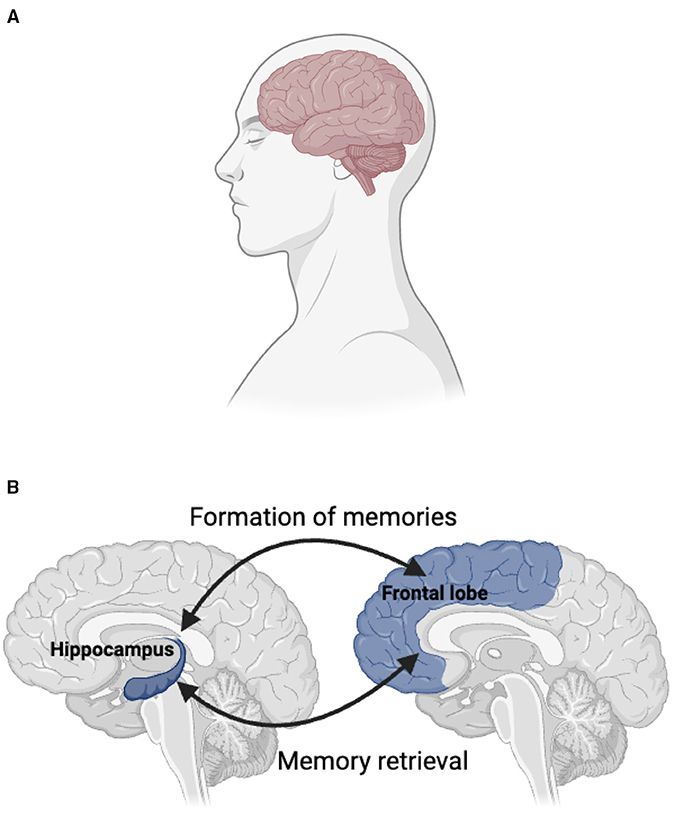
- Figure 1 - (A) Brain orientation inside the human head (Image created with BioRender.com).
- (B) The hippocampus and the frontal lobe communicate with each other to both form memories and retrieve (remember) them (Image created with BioRender.com).
Most seizures occur in the brain’s frontal and temporal lobes. A seizure in the frontal lobe can result in difficulties associated with attention, working memory, and motor (movement) planning [1]. An example of impacted working memory is the inability to recall instructions a teacher just gave about an assignment. Problems with motor planning happen when the brain and body do not communicate with each other at the same time, so a person might run into their desk, even though they know to stop before reaching their chair.
The most common epilepsy symptoms that impact learning are tiredness, being easily distracted, processing information slowly, and even missing school due to seizures [2]. The combined impacts of missing school, difficulties with attention and memory, and problems with reading, writing, and math skills might present challenges both during the school years and later in life [3].
Epilepsy can also impact a child’s ability to build and maintain friendships. Children with epilepsy often miss more school, might struggle to make lasting friendships, and might not feel comfortable speaking up in class. They might also feel that they have a hard time finding the words they want to use when expressing their thoughts or feelings.
Children with epilepsy have reported to their parents and teachers that they feel like their learning is impacted by having epilepsy. Teachers and school staff tend to agree that epilepsy impacts a child’s ability to learn [2]. Educators have observed that students with epilepsy have more difficulty communicating their needs, understanding language, and remembering things [2].
School Troubles Associated With Epilepsy
Imagine attending class every day and having difficulty concentrating on what the teacher is saying, or even missing school at least once or twice a week. These are things that your peers with epilepsy might experience. Nearly half of the children who are diagnosed with epilepsy also have some form of learning challenges. One of the primary learning challenges associated with epilepsy is attention deficit hyperactivity disorder (ADHD) [1]. ADHD and epilepsy both impact the frontal lobe. While you might think of ADHD as not being able to sit still, it is often associated with inattention. This means that a child with epilepsy could have their thoughts interrupted by side conversations going on in the classroom and might not be able to refocus on what the teacher is saying. Another way you might see inattention in children with epilepsy and ADHD is a shortened attention span, such as only being able to concentrate on a math lesson for about 5 minutes. Not being able to concentrate can have a huge impact on a student’s ability to learn. It might mean they must spend twice as much time at home trying to comprehend their homework because they cannot pay attention to the lesson. It could also mean that they experience more frustration over tasks and have difficulty finishing them, even if you might find those tasks simple. Overall, inattention could lead to learning challenges that prevent children with epilepsy from meeting their academic milestones in reading, writing, and math [1].
Research suggests that ADHD is more common among children whose epilepsy was diagnosed at a young age [1]. Over time, children with an early onset of epilepsy and who have received an ADHD diagnosis tend to experience more frequent seizures, which can make learning even more stressful (Figure 2).
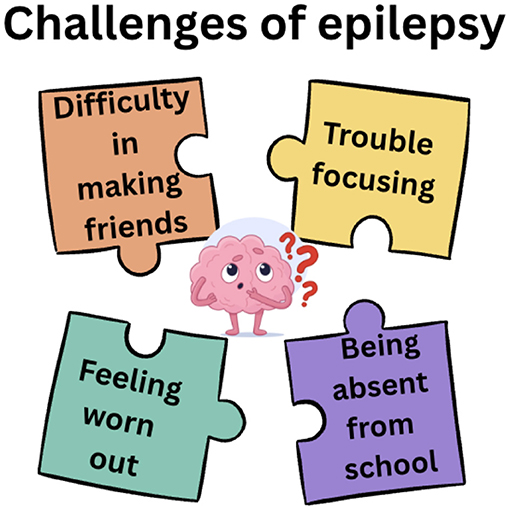
- Figure 2 - Epilepsy can be challenging for learning in several important ways.
- In class, epilepsy can make it difficult to focus on lessons and remember what was taught. However, epilepsy also affects a child’s attendance, social skills, and energy levels (Image created with Canva).
Additionally, children with epilepsy and ADHD tend to have slower processing speeds and difficulties with their working memories as compared to peers of the same age without these diagnoses. In elementary school, you might remember having to log your daily reading time to show that your reading skills were improving. While students without epilepsy might be able to read one chapter during the 20 min they are asked to read daily, their friends with epilepsy and ADHD might only be able to read 2–3 pages during that same time, due to slower processing speeds.
How Can We Improve Learning Environments For Children With Epilepsy?
There are several things that can be done to help students with epilepsy to learn more efficiently. The best thing is to take a whole-child approach. This means that everyone who is involved in the child’s life should work together on a team—including the child’s parents, teachers, doctors, and friends.
One person cannot do all this alone—we must be a community! Parents might help their child with epilepsy by reading with them for a few extra minutes each night or reviewing what they learned in class. Parents can also help by letting their child’s teacher know that the child is struggling in a subject, so the child and teacher can arrange a time to meet outside of class to discuss the lessons. Teachers and educators can help their students with epilepsy by creating lessons that incorporate multimodal instruction methods [2]. Multimodal classrooms might have videos, worksheets, and review slides at the end of class. Using different modes of instruction can help increase the length of time students can remain engaged and can improve working memory. Additional accommodations educators can provide include letting the student use a laptop in class and giving them extra time for tests.
As a peer and friend to a child with epilepsy, you play a very important role in helping create a positive learning environment. Children with epilepsy might feel down because they take more time to complete assignments, or they might not have many friends at school because they are absent frequently due to their seizures. You can help your peers with epilepsy by complimenting them on a project they shared with the class, asking them to study with you, or even talking with them about how hard you found a math lesson to be. These actions will help children with epilepsy feel more comfortable and possibly give them a more positive outlook on their school experience [3]. We all play an essential role in creating positive learning environments, especially for our peers and friends with epilepsy.
Glossary
Epilepsy: ↑ A condition where sudden bursts of abnormal brain activity cause repeated seizures, briefly disrupting how nerve cells communicate and affecting movement, awareness, or behavior.
Seizure: ↑ A sudden change in behavior, movement, or consciousness caused by abnormal electrical activity in the brain.
Neurons: ↑ The building blocks of your brain; a type of messaging system that sends signals throughout your body about what you see, feel, and how to move.
Working Memory: ↑ The mental workspace that lets you hold information in mind for a short time and use it to follow directions, solve problems, or make decisions.
Inattention: ↑ A moment in time when it becomes difficult to focus on a task due to a distraction.
Whole-child Approach: ↑ An interconnected approach to child development that focuses on social, emotional, physical, and cognitive aspects of education, not academic performance alone.
Multimodal: ↑ The use of more than one form of communication to present information in educational environments such as text, pictures, sounds, tables, movement, etc.
Conflict of Interest
The author(s) declared that this work was conducted in the absence of any commercial or financial relationships that could be construed as a potential conflict of interest.
AI Tool Statement
The author(s) declared that generative AI was used for the figures, BioRender.com for Figure 1 and Canva for Figure 2.
Any alternative text (alt text) provided alongside figures in this article has been generated by Frontiers with the support of artificial intelligence and reasonable efforts have been made to ensure accuracy, including review by the authors wherever possible. If you identify any issues, please contact us.
References
[1] ↑ Nickels, K. C., Zaccariello, M. J., Hamiwka, L. D., and Wirrell, E. C. 2016. Cognitive and neurodevelopmental comorbidities in paediatric epilepsy. Nat. Rev. Neurol. 12:465–76. doi: 10.1038/nrneurol.2016.98
[2] ↑ Johnson, E., Atkinson, P., Muggeridge, A., Cross, J. H., and Reilly, C. 2022. Impact of epilepsy on learning and behaviour and needed supports: views of children, parents and school staff. Eur. J. Paediatric Neurol. 40:61–8. doi: 10.1016/j.ejpn.2022.08.001
[3] ↑ Wo, S. W., Ong, L. C., Low, W. Y., and Lai, P. S. M. 2017. The impact of epilepsy on academic achievement in children with normal intelligence and without major comorbidities: a systematic review. Epilepsy Res. 136:35–45. doi: 10.1016/j.eplepsyres.2017.07.009