Abstract
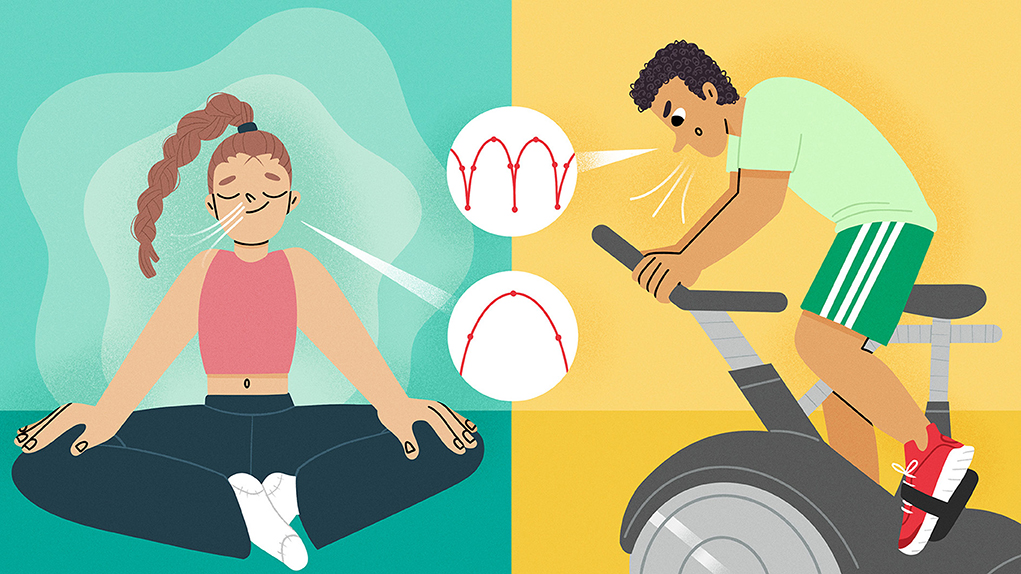
Changing your breathing rate can have many positive benefits for your health, wellbeing, and performance. Breathing usually just happens on its own and you do not think about doing it. However, you can also deliberately control your breathing rate to speed it up and slow it down. Through these breathing techniques, you can specifically influence your autonomic nervous system, which is the body’s system to control automatic responses to stress and the ability to rest. By taking control of your autonomic nervous system, you can create different states in your body and mind, which can influence your physical and mental performance. Research has shown that slow breathing and fast breathing can help improve mental and physical performance. You can use these techniques in a range of environments, like sports or school, to control your mind and body and promote better performance.
The Power of Breathing
Imagine a tool you could use to help you boost the performance of your mind and body. Well, it is closer than you think, it is your lungs! By simply changing your breathing, you can unlock so many benefits. Did you know that our normal breathing rate is around 12–20 breaths per minute (one breath is counted as breathing in and out) [1]. Breathing techniques are different depending on how fast or slow a person breathes is known as their breathing frequency. This article will focus on two main breathing techniques: slow-paced breathing and fast-paced breathing.
Slow-paced breathing means breathing at half the normal breathing rate, or sometimes even less, a frequency of around six breaths per minute. Slow-paced breathing can help you control stress, feel more relaxed, and think more clearly, especially in stressful situations [2].
Fast-paced breathing means breathing much faster than the normal rate, with a frequency of between 25 and 60 breaths per minute. Fast-paced breathing can help you feel more alert and ready for physically challenging tasks, like a 100 m sprint or lifting weights [2].
The Body’s Response to Different Breathing Frequencies
So, what happens in your body and mind when you change your breathing frequency? If you put two fingers on your wrist to feel your pulse, you will notice that when you breathe in, your heart rate speeds up, and when you breathe out, your heart rate slows down. This phenomenon is called respiratory sinus arrhythmia [3]. It is completely normal and shows that your heart is strong and healthy (Figure 1). Have you ever been told to take a deep breath out when you were stressed or anxious? By doing this, you were reducing your heart rate without even knowing it, which may have helped you to feel calmer.
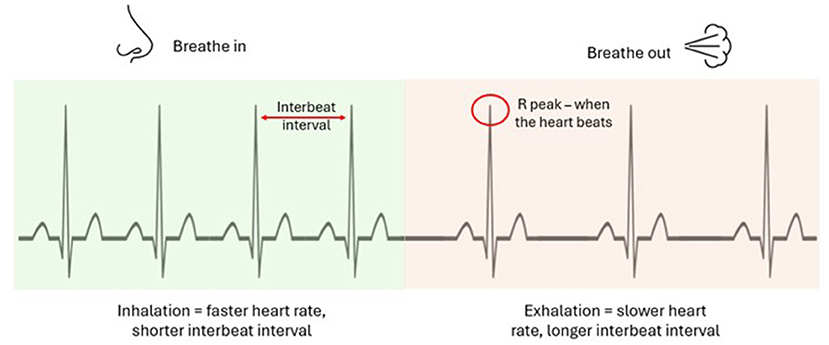
- Figure 1 - This graph shows the electrical activity of the heart.
- The largest peak, labeled R, is when the heart beats. The green section shows inhalation, and the red section shows exhalation. You can see that the heart rate speeds up during inhalation and slows down during exhalation. This phenomenon is called respiratory sinus arrythmia.
Heart rate changes are controlled by the brain, specifically by the autonomic nervous system. This system regulates your body without you even thinking about it, which helps you to react to the challenges you face in everyday life. The autonomic nervous system has two parts: “fight or flight” (also called the sympathetic nervous system) and “rest and digest” (also called the parasympathetic nervous system). When you have more sympathetic activity, your body and mind are more activated and alert, whereas if you have more parasympathetic activity, your body and mind are more relaxed. Breathing techniques activate these different parts of the autonomic nervous system and therefore promote different experiences within your body and mind (Figure 2).
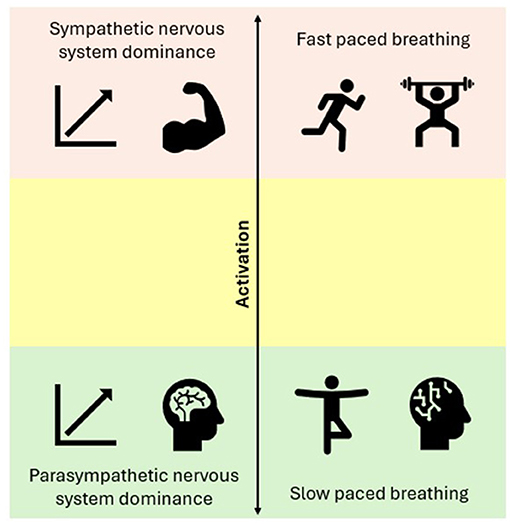
- Figure 2 - The autonomic nervous system regulates many of your body’s functions without the need to think about it.
- It has two parts: the sympathetic nervous system, which makes you more active and alert, and the parasympathetic nervous system, which calms you. Fast-paced breathing activates the sympathetic nervous system, while slow-paced breathing activates the parasympathetic nervous system.
During slow-paced breathing, you increase parasympathetic activity due to activating the vagus nerve [4]. This nerve is responsible for slowing down your heart rate and is directly connected to the brain! Not only do you get great benefits like feeling more relaxed, but this also helps your brain work more effectively, particularly in difficult tasks such as decision making or emotional regulation. Slow-paced breathing helps you to remain calm and clear, a skill that is very important during challenging tasks where you need to think clearly and make good decisions [5] (To read more about how slow-paced breathing benefits your health, see this Frontiers for Young Minds article).
During fast-paced breathing and hyperventilation (deep breaths at a pace of 20–30 breaths per minute) you actively slow the activity of the vagus nerve to increase sympathetic activity, increase your heart rate, and be ready for action! This creates a “fight or flight” response where you have more oxygen directed toward your muscles, and also creates more energy for your body to meet the demands you are facing. For example, fast-paced breathing is useful before lifting heavy weights in the gym, when you need maximum strength to lift them successfully, or at the beginning of a sprint race, to ensure you are as fast as possible.
How Can I do Slow-Paced Breathing?
Maybe you would like to give these methods a try and see how they feel. We will focus on slow paced breathing (Please note that, when you start out, these breathing techniques are best completed with the help of a trained expert).
The first thing you need to do is to make sure you are breathing with the best technique, which involves using your belly. Put one hand on your chest and one hand on your belly, and start to breathe slowly. As you breathe in, your belly should move out and your chest should not move. If you feel your chest moving, try to focus on pushing your belly out when inhaling (imagine your belly is a balloon filling up with air). Then exhale all the way out and bring your belly button close to your spine. By doing this, you are fully using your diaphragm muscle (the main muscle involved in breathing), which helps strengthen this muscle so that the lungs can work more efficiently.
Slow-paced breathing can be done using a breathing pacer (Figure 3), often through an app on a mobile phone, smart watch, or computer. One example of a breathing pacer uses a little ball that helps you pace your breathing to achieve six breaths per minute. As the ball goes up you breathe in and as the ball goes down you breathe out. Other breathing pacers might have moving graphics that go up and down in time with breathing, or a circle that gets bigger and smaller to indicate when you should breathe in and out. Using a pacer helps you breathe at the correct pace, to make sure you get all the benefits we talked about above. Also, with a breathing pacer, you do not have to count every breath in seconds to breathe at the correct frequency.
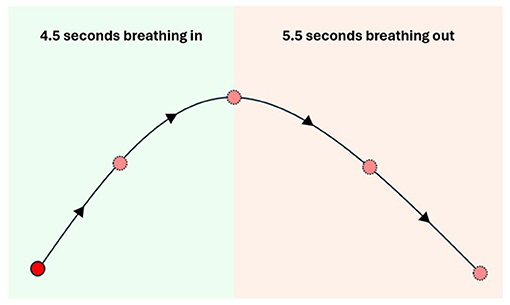
- Figure 3 - Breathing pacer apps can help you perform slow-paced or fast-paced breathing.
- In this example for slow-paced breathing, the little red ball moves up to indicate when you should breathe in, and it moves down to tell you when to breathe out.
Research recommends that you spend a slightly longer time breathing out than in, as this helps to increase parasympathetic activity [6]. You can use a similar approach for fast-paced breathing, for example setting the breathing pacer to achieve 30 breaths per minute (a 1-s inhalation and a 1-s exhalation). You should shift your focus to using a shallower inhales and exhales, like taking small sips of air rather than a big gulp, which helps to maintain a faster breathing frequency [7].
When Should I Change My Breathing Frequency?
The best thing about controlling your breath is you can do it anytime, anywhere! You always have your lungs with you! You could use slow-paced breathing when you are doing something that is important to you and that might make you feel nervous, like a sports competition, a singing performance, or before/during a test at school. In a study where student athletes learnt how to do slow-paced breathing, they said they used it for their sporting performances, academic studies, and at bedtime to help them go to sleep [8]. They specifically said it helped them to feel calmer, reduce stress, and manage nervousness [8]. In addition to these momentary needs, practicing slow-paced breathing helps to strengthen your parasympathetic response.
You might want to use fast-paced breathing when you need to become more activated and boost your energy levels. For example, say you have had a long day at school, followed by a training session that includes sprints. You could use fast-paced breathing when you arrive at training and directly before the sprints, to get your body ready for the session. Research has shown that, when doing fast-paced breathing, hand grip strength improved compared with normal breathing [7]. This means that when you need more physical strength, speeding up your breathing could provide a physical boost!
Research around breathing has clearly highlighted its importance in performance and wellbeing. When used correctly, breathing techniques can have many positive benefits! We encourage you to think about how you are using your breath to help change the way you think, feel, and behave during times where you need to be the best version of yourself. Remember, breathing is a superpower!
Glossary
Breathing Frequency: ↑ The number of breaths you take per minute.
Respiratory Sinus Arrhythmia: ↑ The natural change in heart rate while breathing. Your heart beats faster when you breathe in and slower when you breathe out.
Autonomic Nervous System: ↑ The branch of the nervous system that controls body functions that happen automatically without you thinking about them, like breathing and digestion.
Sympathetic Nervous System: ↑ The branch of the autonomic nervous system that is involved in the fight or flight response. It helps to increase heart rate and breathing rate prior to demands.
Parasympathetic Nervous System: ↑ The branch of the autonomic nervous system that is involved in the rest and digest response. It helps to slow heart rate and breathing rate, regulating your body.
Vagus Nerve: ↑ The 10th cranial nerve, which controls parasympathetic functions in the heart, lungs, and digestive system. It helps regulate heart rate, breathing, digestion, and relaxation.
Diaphragm: ↑ A muscle located under your lungs that helps you breathe. When you inhale, it moves down, filling your lungs with air. When you exhale, it moves up, pushing air out.
Conflict of Interest
The author(s) declared that this work was conducted in the absence of any commercial or financial relationships that could be construed as a potential conflict of interest.
AI Tool Statement
The author(s) declared that generative AI was not used in the creation of this manuscript.
Any alternative text (alt text) provided alongside figures in this article has been generated by Frontiers with the support of artificial intelligence and reasonable efforts have been made to ensure accuracy, including review by the authors wherever possible. If you identify any issues, please contact us.
References
[1] ↑ Sherwood, L. 1995. Fundamentals of Physiology: A Human Perspective. Brooks/Cole Publishing Company, 704. Available online at: https://books.google.com/books/about/Fundamentals_of_Physiology.html?hl=&id=LQCuQgAACAAJ (Accessed July, 2025).
[2] ↑ Laborde, S., Zammit, N., Iskra, M., Mosley, E., Borges, U., Allen, M. S., et al. 2024. The influence of breathing techniques on physical sport performance: a systematic review and meta-analysis. Int. Rev. Sport Exerc. Psychol. 17:1222–77. doi: 10.1080/1750984X.2022.2145573
[3] ↑ Berntson, G. G., Cacioppo, J. T., and Quigley, K. S. 1993. Respiratory sinus arrhythmia: autonomic origins, physiological mechanisms, and psychophysiological implications. Psychophysiology 30, 183–96. doi: 10.1111/j.1469-8986.1993.tb01731.x
[4] ↑ Laborde, S., Allen, M. S., Borges, U., Dosseville, F., Hosang, T. J., Iskra, M., et al. 2022. Effects of voluntary slow breathing on heart rate and heart rate variability: a systematic review and a meta-analysis. Neurosci. Biobehav. Rev. 138, 104711. doi: 10.1016/j.neubiorev.2022.104711
[5] ↑ Laborde, S., Allen, M. S., Borges, U., Hosang, T. J., Furley, P., Mosley, E., et al. 2021. The influence of slow-paced breathing on executive function. J. Psychophysiol. 36, 13–27. doi: 10.1027/0269-8803/a000279
[6] ↑ Laborde, S., Iskra, M., Zammit, N., Borges, U., You, M., Sevoz-Couche, C., et al. 2021. Slow-paced breathing: influence of inhalation/exhalation ratio and of respiratory pauses on cardiac vagal activity. Sustainability. 13, 7775. doi: 10.3390/su13147775
[7] ↑ Telles, S., Sharma, S. K., Yadav, A., Singh, N., and Balkrishna, A. 2014. Immediate changes in muscle strength and motor speed following yoga breathing. Indian J Physiol Pharmacol. 58, 22–9.
[8] ↑ Mosley, E., Duncan, S., Jones, K., Herklots, H., Kavanagh, E., and Laborde, S. 2024. A smartphone enabled slow-paced breathing intervention in dual career athletes. J. Sport Psychol. Action. 15, 149–64. doi: 10.1080/21520704.2023.2194256