Abstract
Have you ever seen big bags of sand stacked on a beach during storms? These are sandbags, used to protect buildings and roads from waves and floods. While they can be useful during emergencies, they can cause serious environmental problems if they are left behind. Most sandbags are made of plastic, and they can slowly break into small pieces that can harm animals, plants, and even people. Abandoned sandbags can change how sand naturally moves, kill plants, and make it hard for animals like sea turtles to live or nest. Also, the sand used to fill sandbags is often taken from the beach or dunes, which causes even more erosion. To protect our coasts and restore natural ecosystems, we must switch to biodegradable bags and remove sandbags after use. This article shows how a quick fix can turn into a long-term problem and why it important for everyone to help protect coastal environments.
Sandbags: A Double-Edged Solution
Have you ever seen big bags of sand stacked along a beach or near a house during a storm? These are called sandbags, and they are often used to stop waves or floodwaters from damaging buildings, roads, and natural areas (Figure 1) [1]. Sandbags can be helpful during emergencies, but what happens when the storm is over, and the bags are left behind? It turns out that sandbags can cause serious problems for nature.

- Figure 1 - (A) Small red plastic sandbags placed along a coastal road.
- These bags were meant to protect the road, but many are broken and scattered. Some plastic pieces are already entering the sea. (B) A long line of giant sandbags used to protect a road very close to the ocean. These heavy bags are placed like a wall, but they change how the beach works and may cause erosion nearby. (C) Sandbags are stacked near homes and restaurants on the beach. The sea is reaching the buildings, and the sandbags are breaking apart, spreading plastic into the water and onto the sand.
Sandbags are usually made from plastic materials like polypropylene or polyethylene. These plastics are strong, lightweight, cheap, and easy to carry. During an emergency, people fill the bags with sand and stack them like bricks to build small walls. These walls are meant to block water from moving further inland and damaging buildings, roads, or ecosystems. Sandbags are especially helpful when floods, storm surges, or high waves threaten a coastal or river town [2].
Where Does the Sand Come From?
Before sandbags can be used, they need to be filled with sand. But where does that sand come from? Often, people take it straight from beaches, dunes, or rivers. This might seem easy, but it hurts nature and makes erosion worse (Figure 2).
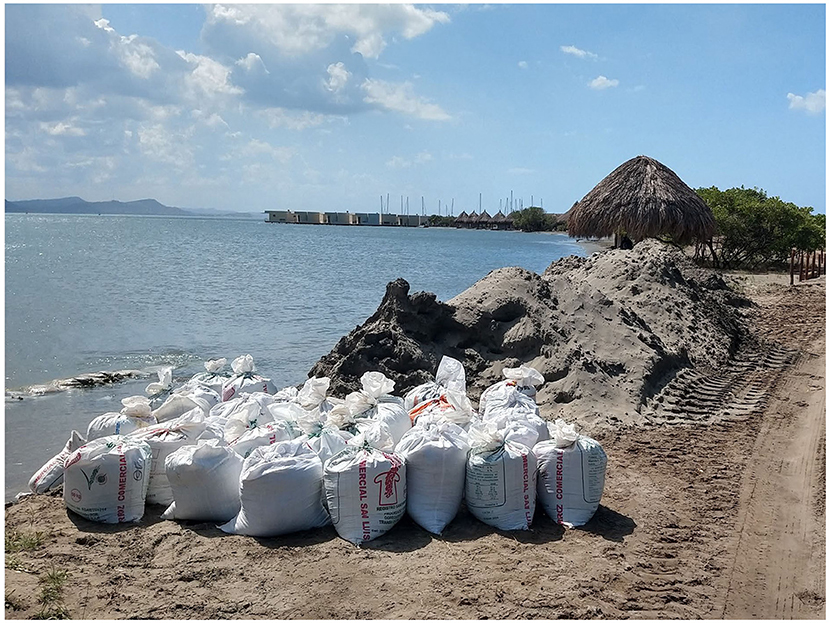
- Figure 2 - Sandbags filled with sand taken directly from the adjacent beach and piled near the shoreline.
- While these bags may be used as an emergency barrier, the extraction of sand from this location accelerates erosion and alters the natural coastal landscape.
When sand is removed from dunes, the plants that hold the dunes in place are disturbed, while taking sand from rivers can change the channel’s shape and affect water quality. Taking sand from beaches and dunes to fill the bags makes these landforms more vulnerable to erosion. In some cases, more harm is done from collecting sand than a storm would have caused!
One reason sandbags are so popular is because they can be transported and put into place quickly. In a matter of hours, work teams can place hundreds or even thousands of sandbags along a beach or in front of buildings. Low cost makes sandbags more attractive than other protection approaches.
Sometimes sandbags are used for longer-term protection. For example, they might be placed in front of hotels, beach houses, or roads where property is being eroded by the sea. In such cases, bigger and stronger versions of sandbags are used, sometimes as big as a car. These giant bags are made of tough fabrics, filled with large amounts of sand to build semi-permanent walls or even artificial dunes. But even though sandbags help for a while, they are not meant to stay forever.
What Happens When We Leave Sandbags Behind?
Once the storm or emergency is over, the sandbags are often left behind. They remain on the coast, exposed to the sun, wind, rain, and waves. Over time, these forces damage the bags. The plastic becomes brittle and starts to break into small pieces [3]. This process can take a very long time, often 10–30 years or more, so the plastic keeps breaking into smaller pieces for many years, releasing microplastics into nature. These tiny pieces of plastic get mixed with the sand, stuck in plants, buried in dunes, or float into the ocean.
For example, in Colombia, on a beach called Puerto Velero, sandbags were placed to protect tourist bungalows from coastal erosion. After the storm passed, the sandbags were abandoned (Figure 3). Eventually, they broke apart, leaving visible plastic pieces scattered across the beach. The beach slope changed, and nearby areas started to erode faster because the sandbags had blocked the natural movement of sand.

- Figure 3 - (A) A group of white sandbags placed around a small beach hut.
- These were likely used during a flood, but they were not removed afterward. (B) A broken wooden dock surrounded by torn plastic sandbags and scattered debris. Some of the plastic is already mixed with the sand and water. (C) A beach filled with broken, abandoned sandbags. Pieces of plastic are mixed with sand, plants, and rocks. This creates pollution that is hard to clean up and harmful to nature.
Similar situations have been seen in other countries. In Vietnam, plastic sandbags are often used to protect tourist resorts. But many are left behind after storm events, leading to plastic litter on nearby beaches and dunes. In Uruguay, after floods and heavy rains, sandbags are used to block rivers from flooding towns. But when the rainy season ends, plastic bags can be found tangled in tree roots, mixed into sediments where a river meets the sea (where fresh water and saltwater mix), or stuck in mangrove forests—trees that grow in salty coastal waters, with roots that stick out of the water and help protect the coast.
Sandbags Can Harm Coastal Nature
Coasts are always changing because of waves, tides, currents, and wind. These natural forces shape beaches and dunes every day. Beaches and dunes naturally move and change shape over time. Sandbags interfere with this natural movement. When sandbags block the normal flow of sand, they may cause nearby areas to erode faster.
Also, sandbags can smother dune vegetation. Plants such as dune grasses and shrubs are very important because they trap sand and keep dunes stable. But if sandbags are placed on top of these plants, the plants die, and the dunes wash away faster. Without plants, the dunes are more likely to erode. Animals that live on or visit the coast are also at risk. Sea turtles, for example, return to beaches to lay their eggs. If the beach is covered in broken sandbags or plastic strips, the turtles might not find a good place to nest.
Sandbags Create Microplastics
As plastic sandbags break down, they release tiny pieces called microplastics. Microplastics are so small (often less than 5 mm across) that they are hard to see, but once mixed with sand and water they can stay for many years without disappearing. Because they stay in the sand and water for so long, microplastics can harm animals and even humans, traveling with the wind, waves, and tides into the ocean where fish, crabs, seabirds, and other animals may accidentally eat them. Sea animals take in microplastics in different ways. Some swallow them by accident when they filter or drink seawater that has plastic pieces floating in it. Others eat smaller animals, like plankton or shrimp, that already have microplastics inside. This way, plastics move up the food chain and can even reach people when we eat seafood. This means microplastics could end up hidden on our plates.
Even worse, microplastics carry harmful chemicals because plastics are made with additives like stabilizers, colorants, and plasticizers, which can leak into the environment when the plastic breaks apart [3]. These substances may harm plants, animals, and people too. Some of these chemicals can interfere with hormones or reduce an animal’s ability to reproduce. Over time, the combination of physical damage, chemical pollution, and visual clutter adds up. Tourists may avoid beaches filled with shredded plastic bags. So local communities that depend on tourism suffer economically as well. The consequences of a forgotten or abandoned sandbag can last for years.
A Need For Rules And Data
In many places, governments and local authorities do not set clear rules for when to use sandbags and how to remove them after emergencies. Sometimes thousands of sandbags are placed during just one storm or flood. But because most countries do not count or keep records, we do not know the total number used worldwide. Most people think of plastic bottles, bags, and fishing nets when they hear about plastic pollution. Sandbags often are not included in beach litter studies. Why? Because they break into small fibers that are hard to see and are often buried in the sand or stuck in plants. This makes their pollution “invisible”.
Unfortunately, there is also a lack of rules or guidelines for using and removing sandbags. In many countries, people can use sandbags without any plan for cleaning up later. This lack of management needs to change. Scientists and environmental groups must call for better regulations and conduct more research on sandbag-related pollution.
Also, it is important to understand how sandbags degrade in different environments. A sandbag left under strong sunlight will break down faster than one buried in cool, damp sand. For better decisions, databases should record both how fast sandbags break apart in different places and what materials they are made of. Knowing how fast sandbags break apart helps scientists predict how much pollution they may cause. This kind of information is essential for making better decisions in the future.
What Should We Do From Now On?
Sandbags are sometimes necessary during emergencies. But we should use them wisely. Here are some better ideas for the future:
• Use biodegradable bags. Biodegradable bags are made from natural fibrous materials like jute or burlap, and they break down over time without polluting the environment [4]. Today, these bags exist in some places, but they are still less common than plastic bags. As more people ask for them, they will become easier to find.
• Remove sandbags after use. Once the storm is over or the risk has passed, recover the sand, remove the bags, and dispose of them properly. Leaving the bags behind only creates long-term problems.
• Avoid using beach or dune sand. Sand for filling bags should come from approved sources that do not harm the environment. This way, we avoid making erosion worse by removing sand directly from coasts.
• Use nature-based solutions. Planting grass on dunes, restoring mangroves, or building “living shorelines” with shells and plants can help protect coasts in a natural and sustainable way. These natural barriers protect communities while also giving homes to animals and plants.
• Do not build too close to the shore. One of the best solutions is prevention: avoid placing houses, roads, or hotels in areas that are naturally exposed to waves, storms, and flooding.
• Include sandbags in environmental plans. Governments and emergency agencies should create clear rules for using and removing sandbags, so they do not end up forgotten and polluting beaches.
In addition, there are ways that everyone can play a role. For example, schools can organize beach clean-ups where abandoned sandbags or plastic fibers are collected. Young people can ask questions and share what they learn with friends and family. Communities can demand better solutions from local leaders, and scientists can design new ways to make protective bags safer for nature. By combining smarter materials, better planning, and community action, we can protect the coasts without creating new pollution problems.
Protecting Our Coasts the Right Way
Sandbags can be helpful tools in emergencies, but they should not become permanent fixtures on our coastlines. If we ignore them after the danger is gone, they become pollutants that harm animals, plants, and people. By using better materials, removing sandbags on time, and choosing smarter coastal protection strategies, we can make sure our beaches, dunes and other natural areas stay clean, beautiful, and safe.
You can be part of the solution. Learn about coastal protection, ask questions, and share what you discover with your friends and family. The more people know, the better choices we can make for the future of our planet. We need your help to keep coasts healthy—not just for today, but for the years and generations to come.
Glossary
Sandbags: ↑ Big bags filled with sand used to stop water from flooding streets, buildings, or beaches during storms.
Plastic: ↑ A man-made material that is strong, light, and lasts a long time—but it can become pollution if not cleaned up.
Dunes: ↑ Hills of sand found near beaches, often covered with plants, that help protect the coast from wind and waves.
Erosion: ↑ When waves and wind wear away parts of the beach, cliffs, or dunes, causing the land to shrink or disappear.
Microplastics: ↑ Tiny plastic pieces, smaller than a grain of rice, that come from bigger plastic items breaking down over time.
Biodegradable: ↑ Something that can break down naturally over time without harming the environment, like paper or plant-based bags.
Nature-based Solutions: ↑ Ways to protect the environment by using natural things like plants, trees, or shells instead of man-made materials.
Conflict of Interest
The author(s) declared that this work was conducted in the absence of any commercial or financial relationships that could be construed as a potential conflict of interest.
AI Tool Statement
The author(s) declared that generative AI was not used in the creation of this manuscript.
Any alternative text (alt text) provided alongside figures in this article has been generated by Frontiers with the support of artificial intelligence and reasonable efforts have been made to ensure accuracy, including review by the authors wherever possible. If you identify any issues, please contact us.
References
[1] ↑ Williams, A. T., Rangel-Buitrago, N., Pranzini, E., and Anfuso, G., 2018. The management of coastal erosion. Ocean Coast. Manag. 156:4–20. doi: 10.1016/j.ocecoaman.2017.03.022
[2] ↑ Gracia, A., Rangel-Buitrago, N., Oakley, J. A., and Williams, A. T. 2018. Use of ecosystems in coastal erosion management. Ocean Coast. Manag. 156:277–89. doi: 10.1016/j.ocecoaman.2017.07.009
[3] ↑ Muñiz, R., and Rahman, M. S. 2025. Microplastics in coastal and marine environments: a critical issue of plastic pollution on marine organisms, seafood contaminations, and human health implications. J. Hazard. Mater. Adv. 18:100663. doi: 10.1016/j.hazadv.2025.100663
[4] ↑ Nayanathara, P. G. C., and Ratnayake, A. S. 2024. The world of plastic waste: a review. Cleaner Mater. 11:100220. doi: 10.1016/j.clema.2024.100220