Abstract
Animals, like people, need vitamins to stay healthy, including salmon. Without enough vitamin B1 (also called thiamine), salmon can struggle to swim and can develop serious health problems that may lead to death. Recently, we noticed young salmon in California showing these symptoms and we soon discovered they were lacking this important vitamin. To help solve this problem, we teamed up with local students. Through the Spinning Salmon Program, high schoolers are collecting data to help us understand how the lack of vitamin B1 can lead to thiamine deficiency and how this is impacting California salmon. These students are helping us discover how much thiamine salmon need to survive by observing behavior and tracking survival of young salmon raised in their classrooms. Through gathering data and reporting their findings, they are making a big impact and helping researchers like us find ways to protect California’s salmon populations.
The Mystery of the Missing Vitamin
Have you ever wondered why eating your fruits and vegetables are so important? Food gives us the essential vitamins and minerals that our bodies cannot make on their own. These nutrients help our cells function properly but not just in humans; animals need them too! Without them, it can be harder to stay healthy, fight off sickness, and have the energy to move and heal.
But what happens when we do not get enough vitamins or when the foods we eat do not have enough nutrients to keep us healthy? In 2020, our research group saw these effects firsthand with young California Chinook salmon. These young fish, called fry, started behaving strangely; swimming in circles and odd patterns, or laying at the bottom of their tanks (Figure 1). And all the while, many of these fry were dying [1].
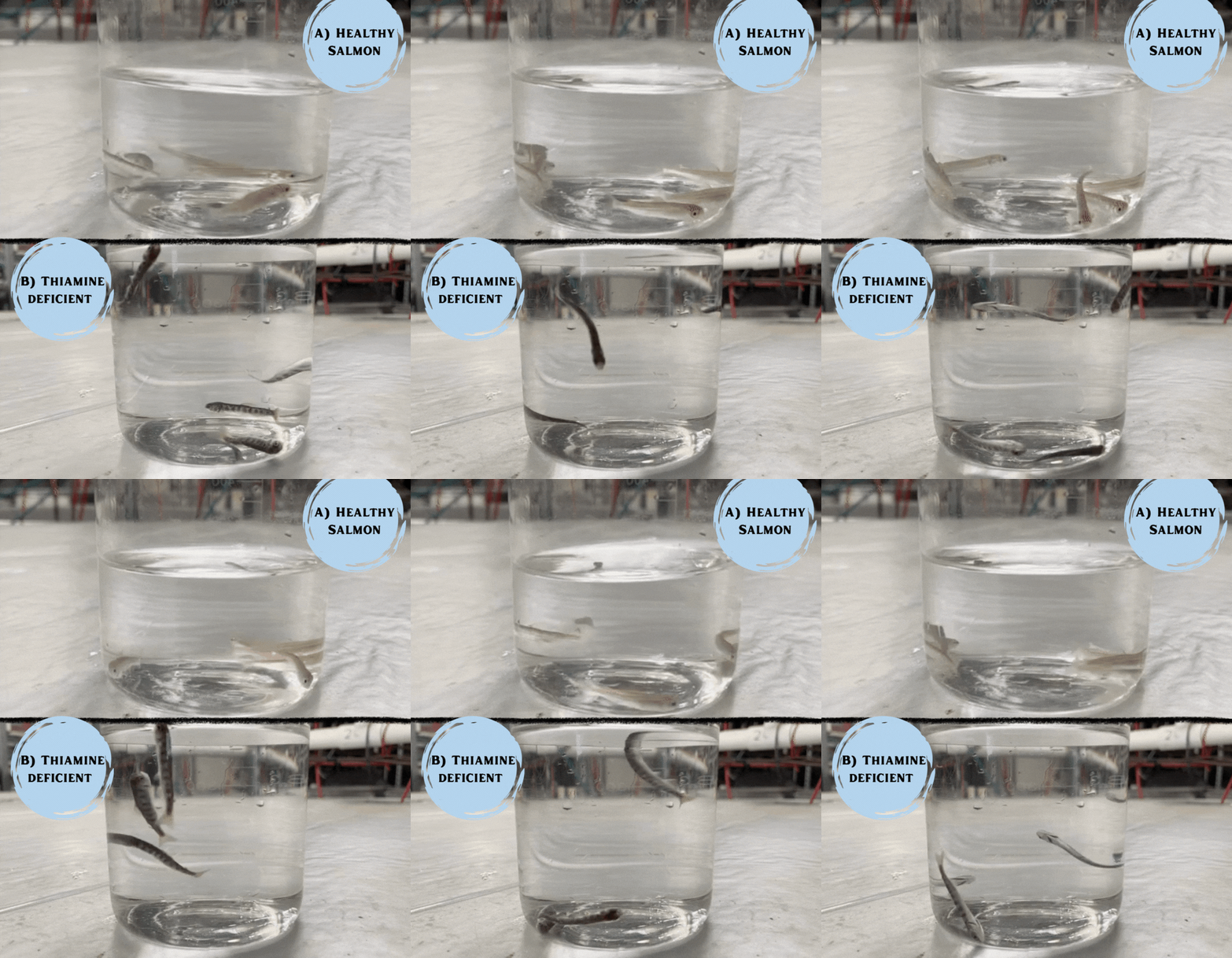
- Figure 1 - When juvenile salmon do not get enough thiamine (which is called thiamine deficiency), they display symptoms including irregular swimming and laying on the bottom of their tanks.
- Some can eventually die. This clip shows the difference between the behaviors of (A) healthy salmon and (B) salmon without proper amounts of thiamine.
As a curious team of scientists, we jumped in to investigate. The cause? A lack of vitamin B1, also known as thiamine. Without enough thiamine, salmon can develop thiamine deficiency complex (TDC), which leads to serious health problems and sometimes death. But why were these young salmon not getting the vitamins they needed? At this stage of life, salmon fry rely on nutrients from the yolk sac, which is passed down from their mothers. If their mothers did not have enough thiamine, the fry would not either. And so we set out to discover what was causing this vitamin shortage.
Salmon have a unique life cycle. They are born in freshwater rivers then migrate to the ocean as adults, eventually returning to the river they are born in to reproduce (Figure 2). This life cycle is called anadromy. Yet suddenly, the salmon returning to their rivers were not carrying enough vitamin B1 to pass on to their young. This left these salmon fry with a much lower chance of survival, since the yolk sacs they were relying on for nutrients did not have enough thiamine. We soon found out why: while in the ocean, Chinook salmon were eating a diet full of anchovies.
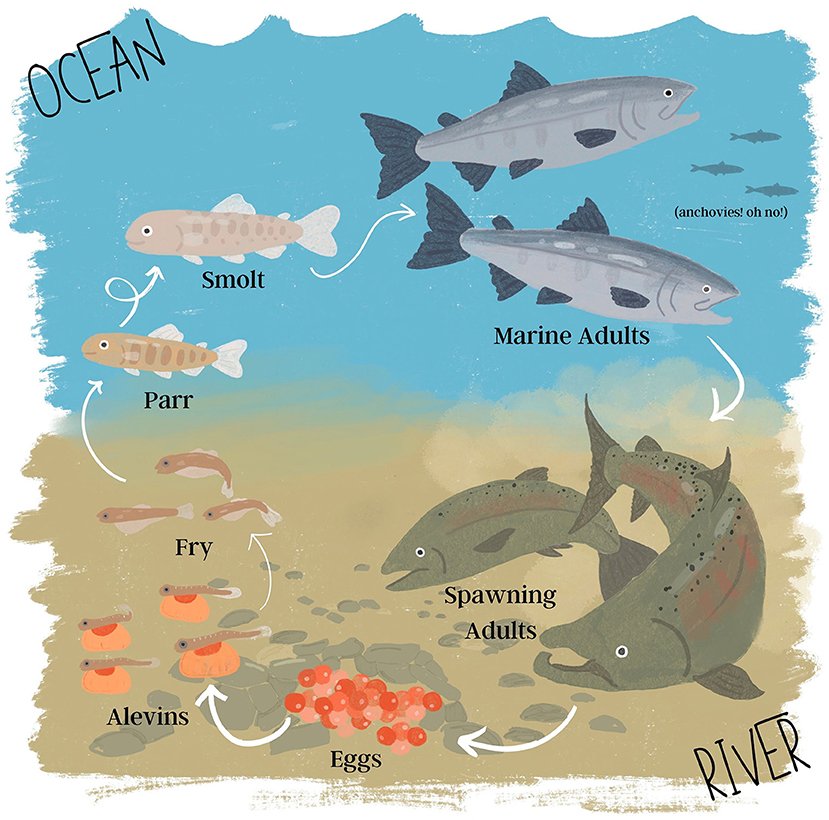
- Figure 2 - Salmon have an anadromous life cycle, meaning they live in both freshwater and saltwater during different life stages.
- Salmon go through numerous changes to move between these two very different environments. They begin as eggs in freshwater rivers then hatch into alevin, which survive on nutrients from their yolk sacs. As they grow into fry and parr, they undergo smoltification, a process preparing them to live in the ocean. After spending several years growing in the ocean (where they may encounter species like anchovies), adult salmon return to their birth rivers to lay eggs and begin the cycle again.
Anchovies create an enzyme called thiaminase, which destroys thiamine. This means that adult salmon feeding on large amounts of anchovies cannot get enough thiamine, and so neither can their offspring [2]. As TDC was being discovered, anchovies were experiencing a population boom, making them a major part of the salmon’s diet. But why are there so many anchovies? And is there any way to help salmon avoid TDC? These were the key questions we asked as we began working to solve this growing problem.
How Much Thiamine is “Just Right”?
California salmon already face many stressors. Climate change and habitat loss make it hard for them to survive [3]. Now, thiamine deficiency is adding to their struggles. Since Chinook salmon are already a threatened species, this new problem could make matters even worse. To help ease the impact of TDC, we started giving vitamin B1 treatments to eggs in hatcheries. By providing a vitamin boost to eggs, we can help juveniles experiencing TDC symptoms to recover! Yet once the young salmon leave the hatchery, they start finding food on their own instead of relying on the yolk sac for their nutrients. If they eat too many anchovies once they travel to the ocean, they still might not get enough thiamine, putting their health and the health of their offspring at risk despite our vitamin treatments. But how much thiamine is enough to remove TDC from the equation? We wanted to understand exactly how much keeps the young fish healthy and nourished.
While we were in the middle of our own research, students in a local school who were raising Chinook salmon fry in their classroom noticed something strange. Their fish were spinning in circles and dying at unusually high rates. Sound familiar? They were seeing the same symptoms of thiamine deficiency that we were! That got us thinking. What if we team up with these future scientists to collect some important data on TDC in salmon? That is when students across California became a part of the research team, helping us track how thiamine deficiency affects salmon. And with that, the Spinning Salmon Program was born!
The Young Scientists Who Found the Perfect Fit
High school students across California became our research partners. In their classrooms, they raised salmon from a local hatchery with no vitamin treatments. These special fish became our “control group”, a benchmark to compare against fish that received extra vitamins in hatcheries. We wondered if the amount of thiamine in yolk sacs given to young salmon by their mothers was enough for them to survive. And if it was, how much did they need to be healthy? Our hypothesis was that salmon fry with very low thiamine would have higher death rates. We also expected they would show more symptoms of TDC. These students set out to see if that was true by collecting real scientific data.
Aquariums were set up in 35 different classrooms. As soon as eggs were delivered, students began recording data. Every day for nearly 2 months, they documented the number of fish that died and observed fish behavior for signs of TDC. Slowly, classrooms became hubs for scientific exploration. Students were making real contributions to ongoing research by using their data to figure out how different thiamine levels in their fish affected the salmons’ health.
The design of these classroom experiments mirrored our own lab studies. Students collected the same data as our scientists, each raising a different salmon population to make our results stronger. At first, we thought we understood the best way to gather this data. But the students surprised us! Their insightful questions and observations helped us improve our scientific process. These young scientists were not just recording numbers. They were actively shaping how we thought about our research. By working together, we gained new perspectives on thiamine deficiency in salmon, learning the best amount of thiamine for healthy fish. The students became a vital part of this scientific community.
Making Waves in Salmon Research
These students were part of a real scientific team. The researchers they worked with were not just names in textbooks. They were real people researching the health of salmon populations in California. By working closely with our scientific team, students realized that real scientists are also asking questions, making observations, and trying to make sense of data, just like they are. Through this collaboration, students and teachers could ask scientists questions. They could also share observations and learn about research experience firsthand. These conversations sparked curiosity and gave students a deeper appreciation for the power of scientific exploration.
This experience did not stop at the classroom. Students also got to explore career opportunities through field trips. Students traveled to university laboratories, salmon hatcheries, and local watersheds. On these trips, they learned even more about the fish they were raising. These experiences showed students how science makes a real difference in the world. They learned how their findings are helping people make important decisions to protect and care for salmon.
Now, the data students carefully collected is making its mark on the scientific community. We wrote an official article based on their discoveries, where students’ data is joined with our researchers’ data (Figure 3). This article will serve as an important guide for understanding TDC in California salmon. Their work is answering a critical question: What thiamine levels do salmon need not just to survive, but thrive? Through their dedication and curiosity, students have made big waves in salmon research. They have shown that young scientists can play a key role in protecting and restoring salmon populations.
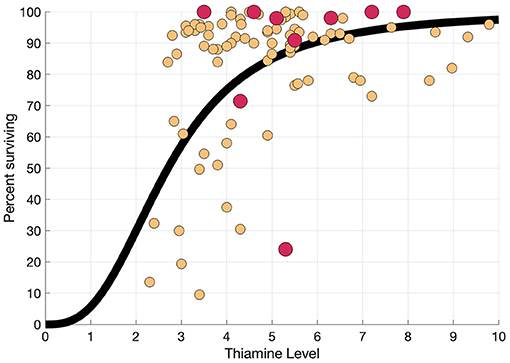
- Figure 3 - Students’ data has been used to help inform how we understand the effects of thiamine deficiency on California salmon.
- This graph shows student data (red dots) combined with data from our research team (orange dots). The data displayed here help us to better understand the thiamine level (x-axis) that gives these salmon the best chance of survival (y-axis). You can see that, with higher thiamine levels, Chinook salmon have a higher percent chance of surviving through these juvenile life stages (Figure credit: Miles Daniels).
Students Shaping the Future
As long as northern anchovy populations remain high, TDC may continue to threaten California Chinook salmon. That is why we are keeping a close watch to make sure these salmon stay healthy in the vast ocean. But the search for answers about thiamine deficiency in California salmon is far from over. There are still many mysteries to unravel.
Teaming up with students is not just about solving a puzzle. It is about protecting a species at risk. This is an important mission to safeguard a species threatened with a changing climate. This collaboration gives young scientists a chance to engage in real research while strengthening their connection to the places they call home. When students feel empowered by science, they are more likely to make a difference in their lives, landscapes, and communities. By working with these students, we gain valuable new perspectives and a wonderful ally in our protection of a vulnerable species. Their curiosity helped shape this project, pushing us as scientists to rethink and refine our approaches. This partnership proves that anyone, at any age, can make a meaningful impact in science.
As we continue exploring the impacts of thiamine deficiency, our work with students remains a beacon of hope for California’s salmon. Together, we are not just uncovering the secrets of the natural world, we are taking real action to protect a species and its fragile ecosystem. The adventure is not over yet. Who knows what new discoveries the next generation of scientists will make?
Glossary
Nutrients: ↑ Substances such as proteins, fats, vitamins, and minerals that are in food and help living things grow, stay healthy, and have energy.
Thiamine: ↑ Also called vitamin B1, a nutrient that helps the body turn food into energy and keeps the brain and nerves working properly.
Thiamine Deficiency Complex (TDC): ↑ A condition that happens when an animal or person does not get enough thiamine, causing weakness or death. It is especially common in fish that eat foods containing thiaminase.
Yolk Sac: ↑ A pouch attached to developing fish and some other animals that provides nutrients before they can feed on their own.
Anadromy: ↑ A specific life cycle in fish where they are born in freshwater, migrate to the ocean to grow and mature, and then return to freshwater to reproduce.
Thiaminase: ↑ An enzyme that breaks down thiamine (vitamin B1), an important nutrient for energy and brain function. Eating too much of it can lead to thiamine deficiency in animals and humans.
Threatened Species: ↑ A type of plant or animal that is at risk of becoming endangered in the near future due to habitat loss, pollution, climate change, or other dangers.
Hypothesis: ↑ A prediction or proposed explanation for a question that can be tested. It is based on what you already know or have observed but want to better understand.
Conflict of Interest
The authors declare that the research was conducted in the absence of any commercial or financial relationships that could be construed as a potential conflict of interest.
Acknowledgments
Funding for this research was provided in part by California’s Department of Fish and Wildlife Proposition 1 Grant #2196012, with teacher engagement supported by NOAA BWET Grant #NOAA-NOS- ONMS-2022-2007153 (Solano County Office of Education) and the GEAR UP College Opportunity Program #P336A190082 (UC Davis School of Education).
AI Tool Statement
The author(s) declare that no Gen AI was used in the creation of this manuscript.
Any alternative text (alt text) provided alongside figures in this article has been generated by Frontiers with the support of artificial intelligence and reasonable efforts have been made to ensure accuracy, including review by the authors wherever possible. If you identify any issues, please contact us.
Original Source Article
↑Mantua, N. J., Bell, H., Todgham, A. E., Daniels, M. E., Rinchard, J., Ludwig, J. M., et al. 2025. Widespread thiamine deficiency in California salmon linked to an anchovy-dominated marine prey base. Proc. Natl. Acad. Sci. USA. 122:e2426011122. doi: 10.1073/pnas.2426011122
References
[1] ↑ Harder, A. M., Ardren, W. R., Evans, A. N., Futia, M. H., Kraft, C. E., Marsden, J. E., et al. 2018. Thiamine deficiency in fishes: causes, consequences, and potential solutions. Rev. Fish Biol. Fish. 28:865–86. doi: 10.1007/s11160-018-9538-x
[2] ↑ Rowland, F. E., Richter, C. A., Tillitt, D. E., and Walters, D. M. 2023. Evolutionary and ecological correlates of thiaminase in fishes. Sci. Rep. 13:18147. doi: 10.1038/s41598-023-44654-x
[3] ↑ Katz, J., Moyle, P. B., Quiñones, R. M., Israel, J., and Purdy, S. 2013. Impending extinction of salmon, steelhead, and trout (Salmonidae) in California. Environ. Biol. Fish. 96:1169–86. doi: 10.1007/s10641-012-9974-8