Abstract
The United Nations’ Sustainable Development Goal (SDG) 4: Quality Education focuses on ensuring inclusive and quality education for all. Education reduces poverty but also supports many other SDGs, from improving health to promoting peace. Yet challenges remain, including shortages of teachers, limited resources, and gaps in reading and math skills. Science and technology help address these barriers by offering new ways for students to learn. A powerful example is artificial intelligence (AI) tutoring, which can guide students step by step, provide personalized feedback, and adapt lessons to various levels. At KAUST, researchers are developing TALEEM, an AI tutor built to support both students and teachers. This article explores how education connects to the SDGs, and how new projects like TALEEM can strengthen skills, build confidence, and support a world where every child has the chance to learn.
Watch an interview with the authors of this article to learn even more! (Video 1).
Learning Today, Leading Tomorrow
The United Nations (UN) created 17 Sustainable Development Goals (SDGs) with the aim of improving the lives of every person, everywhere. These goals include making sure no one is hungry, that our environment is well taken care of, and that economic and educational inequalities are reduced. Education is more than just going to school; it is the key to building a better life. That is why the UN created SDG 4: Quality Education. The goal is simple but powerful: to make sure every child, everywhere, can learn in a safe, fair, and supportive environment. SDG 4 also calls for adults to have chances to keep learning new skills throughout their lives and for teachers to be supported.
Since the world agreed on the SDGs in 2015, millions more young people have entered school. Globally, between 2015 and 2024, 88% of children finished primary school, 78% finished lower secondary, and 60% finished upper secondary. But progress is slowing down and, in some regions, fewer students are reaching the skills they need in reading and math. Unfortunately, hundreds of millions of adults, mostly women, still cannot read or write. In many countries, children, especially those from poorer families or rural areas, do not have the same opportunities as others. Some schools still lack essential needs like electricity, clean water, computers, and even teachers. Without these, students struggle to get the quality of education they deserve.
Education is also a force for change. When children learn, entire societies grow stronger. Education reduces poverty, improves health, creates peace, and even supports other SDGs. For example, education can help decrease inequality by creating decent work opportunities for all, which supports SDG 8 (Decent Work and Economic Growth) [1]. By giving more people the chance to build the skills needed to get better employment in the future, education can also help break cycles of poverty, supporting SDG 1 (No Poverty) [1]. That is why the UN says we must act faster to achieve SDG 4. With only a few years left until 2030, investing in education, especially with new tools like digital technology, can give every child the skills and confidence to spark the collective action needed to achieve the SDGs. So how can science and technology help us solve these challenges?
Learning Powered by Innovation
To achieve SDG 4, we must find creative solutions to some of education’s biggest challenges. This is where science and technology come in. Science is not only about experiments in a lab, but also about finding smart ways to solve big problems. One of the biggest challenges the world faces today is making sure that every child, no matter where they live, has access to a good education. There are many obstacles, including a shortage of qualified teachers in certain areas. Even when teachers are available, in a big class of students with only one teacher, it is hard for every student to get the attention that they need [2]. Even worse, children from poor families, rural areas, or with disabilities often face greater barriers to attending school at all.
These challenging problems require a range of solutions, but science and technology offer several powerful tools to address some of them. Not long ago, computers and the internet were costly and rare. Today, these tools are becoming cheaper and easier to use. Now, many families, even in rural areas, have access to mobile phones and data. This creates new opportunities for students to connect to lessons, even if their schools are far away. Online platforms can provide interactive exercises, video lessons, and even live conversations with teachers. In addition, these modern tools can also adapt to each student’s level. For example, if a student struggles with math, the system can give them easier problems first, then slowly increase the difficulty. This way, every learner can move at their own pace.
Technology can also make learning more exciting and memorable. Virtual reality (VR), for instance, can transport students beyond the classroom, letting them explore the inside of the human body or travel to the surface of Mars without leaving their desks. Science and technology cannot replace teachers, but they can support teachers and students. By providing extra resources, quicker feedback, and new ways to learn, technology helps make education more inclusive, fair, and effective. Among these tools, one stands out as especially powerful for the future of learning.
Meet TALEEM: The AI Tutor
You have probably heard about artificial intelligence (AI) and that many countries are turning to this technology to solve various problems. To support the use of AI in education, KAUST is developing its own innovation: an AI tutor. Since AI is a computer technology that can “think” like humans, we decided to build an AI system that behaves like a personal tutor, guiding students through difficult subjects and offering hints when they get stuck. This project, called TALEEM, is built on the idea that if students receive step-by-step support, rather than being given the answers, they will develop stronger skills and a deeper understanding of the subject.
How TALEEM Works
The team began with Grade 12 mathematics from the Saudi Arabian school curriculum, carefully turning the textbooks into a digital database of knowledge. Imagine this database like a giant web, where each mathematical idea is a point connected to many others. This helps the AI tutor see how concepts are linked together, so it can guide students from one idea to the next, just like a teacher would. Look at Figure 1A for example, which shows a traditional classroom setting. When a student makes a mistake, the AI tutor does not simply say “wrong”. Instead, it gives hints, as shown in Figure 1B.
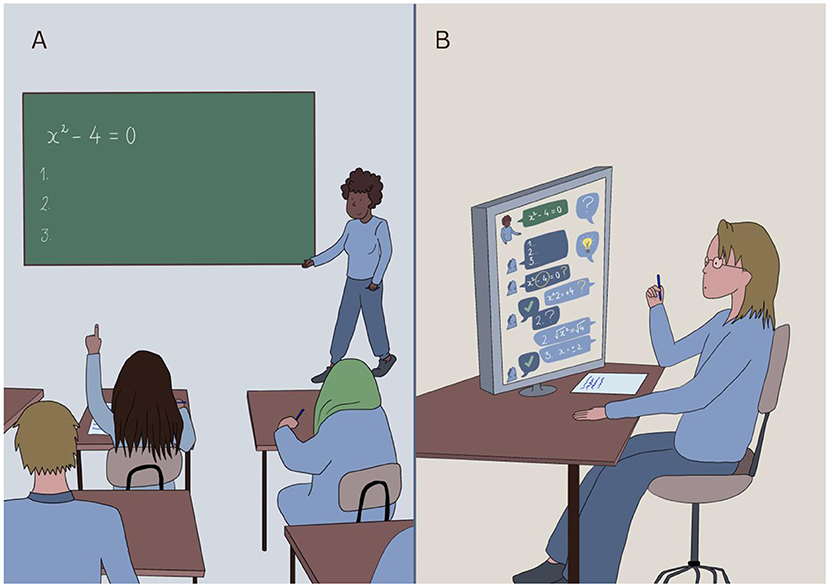
- Figure 1 - (A) A regular classroom, where a teacher presents a math problem and explains the steps taken to achieve the final answer.
- (B) A student using an AI tutor, which provides the same kind of help—nudging the student with clues but without giving them the answer straight away. This approach encourages students to solve problems on their own, builds their confidence, and ensures all students can have hints and clues that are made just for them and their way of learning.
The system also has a special “teacher mode”. In this role, the AI becomes a helpful assistant for teachers, helping them to prepare quizzes, suggesting practice questions, or even checking students’ answers. By sharing the workload with an AI assistant, teachers gain more time to focus on what matters most: connecting with their students and helping them grow as life-long learners.
Inside an AI Tutor
To build TALEEM, the team chose a large language model (LLM) called ALLaM. Think of ALLaM as the “brain” inside TALEEM, helping the system understand students’ questions and come up with helpful answers. ALLaM is special because it can speak and understand both Arabic and English, which makes it perfect for helping students in Saudi Arabia. To make sure our AI tutor stays safe and fair, we have also been working on ways to teach LLMs to follow human values. In recent studies, our team showed that there are simple ways to help these models say no to biased or harmful requests while still learning effectively [3, 4]. These improvements help AI tutors like TALEEM guide students in a responsible way and ensure the information they share with students is trustworthy.
To ensure our system worked as best as possible, we paired ALLaM with another powerful AI that acts as a supervisor. The supervisor checks ALLaM’s answers, points out mistakes, and suggests improvements, like a senior teacher training a new assistant (Figure 2). This algorithm helps the tutor quickly become more accurate and reliable.

- Figure 2 - Using a big database of knowledge (A), ALLaM, our AI tutor brain (B), receives questions from a student (C).
- ALLaM then thinks of ways to help the student find the answer without telling them the answer directly (D). The AI supervisor (E) receives the hint ideas from ALLaM and decides which are good hints and which make the problem too easy. The supervisor gives feedback to ALLaM (F) to improve the hints. Good hints are presented to the student, helping them to proceed with the assignment (G). To make sure the tutor continuously improves, all interactions are recorded and stored.
We can also create AI “students” to help our AI tutors practice! In test sessions using our AI students to test our AI tutor, we could make the AI students solve problems more confidently and go from many mistakes to almost perfect accuracy after a few rounds with the AI tutor. These results suggest that human students could also gain a lot from the system’s detailed guidance.
Our Path Forward
The UN’s SDG 4—Quality Education is about making sure everyone has the chance to learn in a safe and supportive environment. Education reduces poverty, improves health, and creates fairer societies. Science and technology play a key role in solving the challenges that block this goal, from teacher shortages to schools without enough resources. The KAUST TALEEM project shows how AI can be part of the solution. By guiding students step by step and helping teachers with their workloads, AI tutors can improve learning outcomes, reduce inequality between students in different regions, and support the targets of SDG 4. Reaching this goal is not only the work of scientists. Students like you also have a role to play. Keep learning throughout your life, support and respect your teachers, and speak up for everyone’s right to education. By doing so, you will help build a world where quality education is a reality for all.
Glossary
Inequality: ↑ Unfair circumstances that cause people to have different access to basic human needs, like housing, food, and education.
Virtual Reality (VR): ↑ A computer-generated world that makes the user feel like they are somewhere else.
Artificial Intelligence (AI): ↑ Computer systems that can “think” or “learn” like humans do. AI does this by analyzing data, which enables it to solve problems, make decisions, and understand language.
AI Tutor: ↑ A digital teacher that works with one student to give extra help and guidance, often focusing on subjects that are difficult to learn.
Database: ↑ A giant digital filing cabinet where information is stored in an organized way. Databases allow people to search, add, or update details when necessary.
Large Language Model (LLM): ↑ A type of AI trained on massive amounts of text, enabling it to create human-like language to answer questions, write text, and help explain things clearly.
Algorithm: ↑ A recipe or a set of step-by-step instructions that a computer follows to solve a problem.
Conflict of Interest
The author(s) declared that this work was conducted in the absence of any commercial or financial relationships that could be construed as a potential conflict of interest.
Acknowledgments
We would like to thank Nicki Talbot for her invaluable support during the development of the Collection, without which it would not have been possible. We also acknowledge Ana Runte for creating the illustrations featured in this article. We further extend our gratitude to the KAUST Office of Sustainability and the UNDP Saudi Arabia Country Office for their dedication to raising awareness of the UN SDGs in our journey toward a more sustainable world.
AI Tool Statement
The author(s) declared that generative AI was used in the creation of this manuscript. The authors acknowledge the use of ChatGPT (GPT-5.1), a generative artificial intelligence model developed by OpenAI, to support language editing, clarity, and structural refinement of the manuscript.
Any alternative text (alt text) provided alongside figures in this article has been generated by Frontiers with the support of artificial intelligence and reasonable efforts have been made to ensure accuracy, including review by the authors wherever possible. If you identify any issues, please contact us.
References
[1] ↑ Spada, A., Fiore, M., and Galati, A. 2023. The impact of education and culture on poverty reduction: evidence from panel data of European countries. Soc. Indic. Res. 175:927–40. doi: 10.1007/s11205-023-03155-0
[2] ↑ Konstantopoulos, S., and Shen, T. 2023. Class size and teacher effects on non-cognitive outcomes in grades K-3: a fixed effects analysis of ECLS-K: 2011 data. Large-scale Assess. Educ. 11:33. doi: 10.1186/s40536-023-00182-8
[3] ↑ Abu Shairah, H., Hammoud, H. A. A. K., Turkiyyah, G., and Ghanem, B. 2025. Turning the spell around: lightweight alignment amplification via rank-one safety injection. arXiv [preprint]. arXiv:2508.20766. doi: 10.48550/arXiv.2508.20766
[4] ↑ Abu Shairah, H., Hammoud, H. A. A. K., Ghanem, B., and Turkiyyah, G. 2025. An embarrassingly simple defense against LLM abliteration attacks. arXiv [preprint] arXiv:2505.19056. doi: 10.48550/arXiv.2505.19056