Abstract
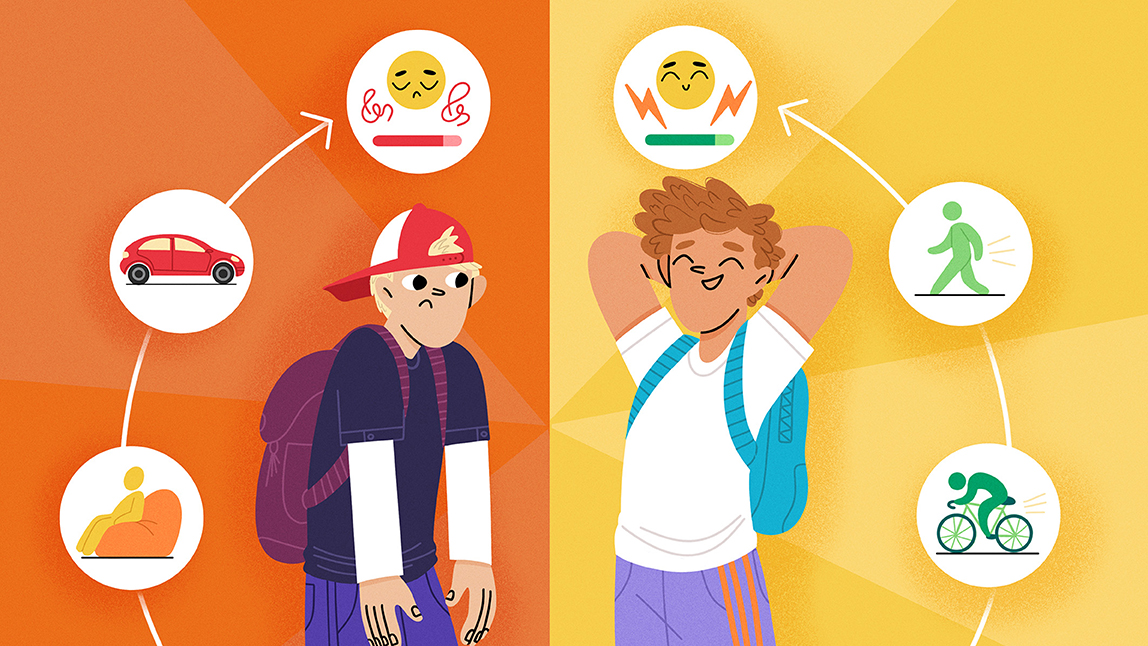
Many teenagers today spend too much time sitting, whether at school, at home, or elsewhere, leading to feelings of tiredness, lack of energy, sadness, or even health issues. A study in Austria aimed to explore whether active mobility, like walking or biking, could improve teens’ wellbeing. Researchers tracked the daily travel, movement, and wellbeing of students aged 12–14 over a week. The findings showed that physical activity, such as walking around without a specific destination, significantly boosted children’s wellbeing. When active travel like biking or walking to school was included, teens were more likely to meet the World Health Organization’s recommended 1 h of physical activity per day. The study found that while regular exercise with moderate or high intensity is very important, integrating active mobility into everyday activities was helpful for improving wellbeing. These results highlight the power of simple, daily movements in enhancing overall health and happiness.
Are Teens Moving Less Than Before?
Imagine spending most of your day sitting—at school, doing homework, or watching TikTok. Does this sound familiar to you? You are not alone. Teens around the world, including those in Austria, are moving less and less. In fact, over 80% of school children do not move enough to stay healthy, says the World Health Organization (WHO). This is also confirmed by studies on the physical activity behavior of Austrian students [1]. Not moving enough is a big deal because it can affect both your body and your mind. The overall trend of moving less is also seen in how children travel: in Austria, the share of trips to school made on foot dropped from 35 to 25% between 1995 and 2014, while trips made by car increased from 17 to 25% [2].
Why is this happening? A lot of it has to do with how we spend our free time. Many teens are glued to smartphones, tablets, and laptops. School also takes up a lot of time, which means there is less chance to run, bike, or just walk outside. And after the COVID-19 lockdowns, things got worse. People stayed indoors more, sports clubs closed, and physical education classes were canceled.
Too Much Sitting, Too Many Problems
When you sit too much and do not move your body, it does not just make you feel tired or stiff—it can also lead to serious problems. In Austria, more and more teens are becoming overweight; mental health is also getting worse [3]. One study showed that four times more young people are dealing with mental health problems compared to 10 years ago. Teens reported feeling sad, tired, and even having trouble sleeping. Furthermore, how kids get around today can shape how they travel when they grow up. If they mostly travel by car as children, they might keep using cars as adults, which can have bad effects on their health, traffic safety, and the environment.
The Power of Active Travel
Here is the good news: even small amounts of movement can make a big difference. You do not have to go to the gym every day. Walking or scootering to school, biking over to a friend’s house, or even going out for a walk just because you feel like it—these are all forms of active mobility. That means getting from one place to another using your own energy.
And guess what? People who walk or bike seem to feel better. They are usually happier, less stressed, and more awake during the day. However, scientists are not yet entirely clear about what this connection looks like, especially for kids, because there is more research on this topic in adults. Furthermore, studies looking at movement in kids often only look at younger children and school trips.
In addition, wellbeing is a tricky thing to measure because it includes many things—like feeling happy, healthy, safe, or confident. For teenagers, wellbeing can be even more complex, since their wellbeing also depends on things like school, friends, family, free time, and how they get around. That is why it is not easy for researchers to agree on just one way to measure it.
What This Study Looked At
We, a group of researchers in Austria, wanted to find out how daily movement affects how children feel. We asked 71 pupils aged 12–14 from three schools in Vienna and Korneuburg (a town north of Vienna) to track their trips, their movements and their wellbeing for 7 days. Each evening, the kids filled out an online travel, activity, and wellbeing diary. This diary included details about where they went, how they got there, how much they moved and with what intensity, and how they felt that day. The idea was not just to look at exercise or sports that take place at certain locations. We also wanted to see how normal, everyday movement between different locations—like walking or biking trips—could help children feel better. We worked together with children to create the questionnaire, making sure the questions were easy to understand and really matched their everyday experiences [3].
What We Found
Here are some interesting things we discovered. We looked at how much kids are following the WHO’s recommendation of getting 1 h of physical activity each day for 7 days. When we only counted activities like organized training and school sports at specific locations, kids were getting about 3.9 days of activity per week (Figure 1). But when we also counted active mobility on trips like walking, scootering, or biking to school, that number went up to 4.6 days a week [4]. That is still too little, but this result shows that active trips really help to improve their overall health.

- Figure 1 - Number of days per week that children fulfill the WHO’s recommendations for physical activity for children and adolescents (red column).
- In addition to physical activity through organized training, sports, etc., if physical activity on trips (such as walking, cycling) is also taken into account, the proportion of days meeting the WHO’s recommendations increases.
Children felt better on days when they were more active, especially if they walked or biked just for fun. It was not just about getting from one place to another, but about enjoying the movement itself. Cycling seemed to be extra special: even though not many kids did it every day, those who did were often happier overall. Walking without a specific destination—just to be outside, for example taking the dog for a walk or chilling around with friends—also helped kids feel better. And while light physical activity did not change much, more intense movement, like playing sports, made a real difference in how good children felt.
It might seem obvious that moving makes people feel good. But the innovative part is how we studied it. Most research asks people to remember how they felt weeks ago, which is not always accurate. But this study collected information on how children felt every single day for a week, taking into account a lot of different things like how they got around, their time at school, and their social lives. This helped us to understand better how all these everyday experiences affect how children feel mentally. That means the results are more trustworthy. And the study did not just focus on sports. It looked at everything, from walking the dog, to cycling to school, to dancing in their rooms.
What Does All This Mean?
So, what can we take away from all of this? The big idea is that moving your body—especially in fun, everyday ways—can really make a difference in how you feel. But not all movement works the same way. In terms of active mobility, if you are walking longer distances for fun, it can actually help you feel happier, more energetic, and less stressed. This effect can occur on a daily level. In contrast, cycling seems to have an effect in the long term: while only a few children biked often in our study, the ones who did tended to feel better overall.
In addition to being active when traveling, other physical activities are also good for your wellbeing. Very strenuous (intense) and moderately strenuous activities showed an effect, especially if they lasted longer. Another finding is that physical activity and active travel work better together. One does not replace the other. So, if children are playing sports and biking or walking during the day, that is even better for their physical and mental health.
But that is not to say that movement fixes everything. How you feel also depends on sleep, school stress, friendships, family, and a lot more. But movement can definitely be one piece of the puzzle that helps improve your overall wellbeing.
Why This Matters (And What Comes Next)
This research shows how important it is to make space for movement in our everyday lives, even if it is just a little. Schools and cities can help by making streets safer for walking and cycling, giving children more time for sports and games, and encouraging fun ways to move—not just during school sports, but anytime. And this is just the beginning. To really understand how movement affects children and teens, we need even bigger studies with more children from all kinds of places and backgrounds.
Glossary
Physical Activity: ↑ Any kind of movement that makes a body work, like running, dancing, fitness training, or playing sports.
Trip: ↑ A journey from one place to another, for example, going from home to school or visiting a friend’s house.
Active Mobility: ↑ Getting from one place to another using your own energy—like walking, biking, or scootering—instead of using a car, bus, or train.
Wellbeing: ↑ How you feel overall, in your body and in your mind. It includes feeling happy, healthy, safe, and comfortable.
Conflict of Interest
The authors declare that the research was conducted in the absence of any commercial or financial relationships that could be construed as a potential conflict of interest.
Acknowledgments
This study was developed within the project “TRA:WELL-transport and wellbeing” (2022–2024) (SPSC 01 030-TRA:WELL), which was funded by the Austrian Federal Ministry of Education, Science and Research under the Sparkling Science 2.0 program. We would like to thank all the project staff for their assistance in conducting the survey. We would also like to thank the schoolchildren who took part in the survey and the school’s principals and teachers for their support during the survey, and the parents who gave their consent.
AI Tool Statement
The author(s) declare that no Gen AI was used in the creation of this manuscript.
Any alternative text (alt text) provided alongside figures in this article has been generated by Frontiers with the support of artificial intelligence and reasonable efforts have been made to ensure accuracy, including review by the authors wherever possible. If you identify any issues, please contact us.
Original Source Article
↑Stark, J., Hössinger, R., Wegener, S., Batiajew, V., and Su, S. (2025). Children’s activemobility, physical activity and well-being. J. Transport Health. 44:102120. doi: 10.1016/j.jth.2025.102120
References
[1] ↑ Maier, G., Friedrich, T., and Felder-Puig, R. 2017. HBSC Factsheet 01 - Das Bewegungsverhalten österreichischer Schülerinnen und Schüler: HBSC Ergebnisse 2014. [HBSC Factsheet 01 - The Physical Activity Behavior of Austrian Students: HBSC Results 2014.]. Federal Ministry for Health and Women (German).
[2] ↑ Tomschy, R., Herry, M., Sammer, G., Klementschitz, R., Riegler, S., Follmer, R., et al., 2016. Österreich unterwegs 2013/2014. Ergebnisbericht zur österreichweiten Mobilitätserhebung. [Austria on the move 2013/2014. Results report on the Austria-wide mobility survey]. Vienna, Austria: Federal Ministry for Transport, Innovation and Technology. (German).
[3] ↑ Felder-Puig, R. 2023. Gesundheit und Gesundheitsverhalten von österreichischen Schülerinnen und Schülern - Ergebnisse des WHO-HBSC-Survey 2021/22 [Health and health behaviors of Austrian schoolchildren - results of the WHO-HBSC survey.]. Vienna, Austria: Federal Ministry of Social Affairs, Health, Care and Consumer Protection (BMSGPK). (German).
[4] ↑ Stark, J., Wegener, S., Batiajew, V., Hössinger, R., and Su, S. 2025. Intersecting Mobility and Physical Activity: A Comprehensive Multi-Day Survey Approach for Assessing Movement Behavior in Early Adolescence. 13th International Conference on Transport Survey Methods (ISCTSC 2025). Da Nang, Vietnam. 30.03.2025 - 04.04.2025.