Abstract
Have you ever heard of radiation? It might sound scary, but it is also something professionals use every day in medicine and science, and even something that must be dealt with during space travel! In this article, we explain what ionizing radiation is, how it can affect our bodies, and why it is important to stay safe around it. You will discover how workers like pilots, doctors, astronauts, and engineers can be exposed to radiation on the job and how special doctors, called occupational medicine doctors, work to protect them. We show that radiation does not have to be frightening, especially when the right safety rules and health checks are in place.
The Incredible Hulk and Radiation: A Story of Strength and Science
Hello, young readers! Today, we are going to explore an exciting topic: ionizing radiation. But first, have you heard of the superhero known as the Incredible Hulk? Hulk is the name that Bruce Banner, a brilliant scientist, takes when he transforms. One day, during an experiment with a special bomb, something incredible happened. Bruce was hit by a mysterious, invisible energy called radiation! From that moment on, his life changed forever.
Now, whenever Bruce gets angry or stressed, he transforms into the Hulk—a huge green creature with incredible strength! But there is a downside: when he becomes the Hulk, he does not think as clearly as before. But what exactly is this radiation that changed Bruce into the Incredible Hulk? Keep reading to find out.
What is Ionizing Radiation?
Radiation is energy that moves through space. Some types of radiation, like light and heat, can be seen or felt. These types of radiation tend to have lower amounts of energy and are called non-ionizing radiation. Other forms, like X-rays and gamma (γ) rays (the ones that transformed Bruce into the Hulk) are invisible, and they have a lot more energy. Thus, these forms are called ionizing radiation [1].
There are two main kinds of ionizing radiation. X-rays and gamma rays are called electromagnetic radiation. The other kind, called particle radiation, contains alpha (α) and beta (β) particles, and neutrons (Figure 1). These types of radiation have different levels of penetration power. For example, alpha particles are so weak that a simple sheet of paper can stop them. Gamma rays, on the other hand, are much stronger—they can pass through lead and need thick concrete to be blocked.
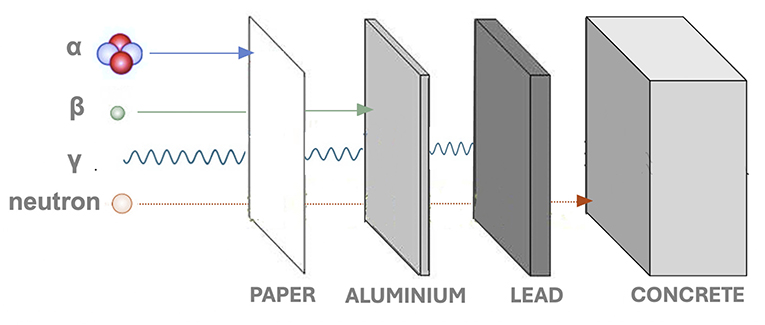
- Figure 1 - This diagram shows how alpha (α) and beta (β) particles, gamma (γ) rays, and neutrons pass through materials like paper, aluminum, lead, and concrete.
- Alpha particles are the weakest and can be blocked by a piece of paper, while neutrons have so much energy that it takes thick concrete to stop them.
Ionizing radiation is very strong and can affect the atoms in our bodies. Atoms are the tiny building blocks of everything around us. Each atom has a center called the nucleus, which holds protons and neutrons (Figure 2). It is like the Sun at the center of the solar system. Around the nucleus, electrons (small particles with a negative charge) move in fixed paths, like planets orbiting the Sun. Normally, atoms have no charge because the positive protons and negative electrons balance each other. But when ionizing radiation hits an atom, it can remove an electron. This turns the atom into a charged particle called an ion, in a process known as ionization.
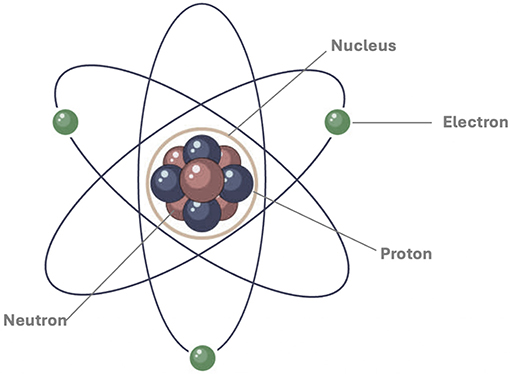
- Figure 2 - An atom with a nucleus made of protons and neutrons.
- Electrons move around the nucleus.
Now that we know what ionizing radiation is, we will explain why it can be dangerous to human health.
Why is Radiation Dangerous?
Radiation can harm our DNA, the genetic code that contains the instructions for how cells work. When ionizing radiation passes through the body, it can hit atoms and knock out electrons. This creates very reactive substances that can change DNA. If the body cannot repair the damage, cells may grow in the wrong way and spread out of control, leading to cancer. The risk depends on how much ionizing radiation the person is exposed to, how long they are exposed, and which body part is affected [2].
Radiation in the Real World
Some sources of ionizing radiation are natural, while others are man-made. Natural sources include cosmic rays from space, radioactive minerals in the ground, and radon gas. Man-made sources include X-rays used in medical procedures, radiation from nuclear power plants, and radiation for industrial uses.
Ionizing radiation is everywhere, but do not worry—most of it is harmless! Cosmic rays from space and natural radiation from the Earth are part of our daily environment. We are exposed to low levels all the time, and they do not harm us. The real concern comes from high doses of ionizing radiation, like X-rays or radioactive materials. So, while it is good to know about radiation, most of it is completely safe.
Where Can Workers be Exposed to Ionizing Radiation?
Even though ionizing radiation exposure can be risky, some workers deal with it every day. Let us look at who these workers are and how they stay safe.
Pilots and Cabin Crew
Pilots and flight crews get more cosmic rays because they fly high. At higher altitudes, Earth’s atmosphere gives less protection from radiation. Airlines limit flying hours and monitor exposure to help keep crews safe.
Astronauts
Astronauts get a lot of ionizing radiation because space has little to no air or magnetic protection. Space agencies create shields and safety rules to keep astronauts safe during missions.
Healthcare Workers
Doctors like radiologists, radiotherapists, and surgeons use ionizing radiation to find and treat diseases. X-ray technicians take images of bones and organs. These professionals use protective gear, follow strict safety procedures, and work behind shielding barriers to reduce exposure.
Nuclear Installations Workers
Getting uranium, using it as fuel, and dealing with nuclear waste involves radiation risks. From mining uranium to disposing of nuclear waste, every step is carefully monitored to protect their health. Workers follow strict protocols, and often work remotely or behind shielding when radiation levels are high.
Industrial Workers
Ionizing radiation is used to create, test, and process materials. It helps check material properties, measure pollution, sterilize, and improve industrial processes. One important use is nondestructive testing (NDT), a method that allows us to inspect materials for defects or weaknesses without breaking or damaging them. For example, in the aviation industry, NDT is used to check airplane wings for cracks or hidden flaws, ensuring they are safe for flight. Safety measures include using remote handling tools, protective barriers, and following time limits to minimize exposure.
Mining and Uranium Workers
Uranium is taken from the ground to be used in nuclear power plants. Workers who mine and process it are exposed to ionizing radiation. Other natural resources, like coal, oil, gas, and minerals, can also have small amounts of radiation. To stay safe, workers use protective clothing, proper ventilation and radiation monitoring devices.
Rules for Ionizing Radiation Exposure
There are rules to protect people from ionizing radiation. In Europe, the Euratom Directive 2013/59 is the most important one [3]. The European Union sets limits on radiation exposure for workers. Companies must monitor workplaces and implement safety measures. Radiation exposure is measured in a unit called the sievert. Workers should not be exposed to more than 20 millisieverts (mSv) of radiation per year. This limit for workers was chosen because science shows that this amount of radiation is still very low and safe if it is spread out over time. It is a balance between keeping people safe and allowing important jobs, like in hospitals or research labs, to be done. These workers also get special training and regular checks to make sure their exposure stays as low as possible.
Euratom also requires training on protective equipment and emergen cy procedures. Regular radiation level checks are needed to ensure safety limits are not exceeded. European countries follow this rule and have updated their laws to comply. These rules are based on new scientific research and advice from the International Commission on Radiological Protection (ICRP), in particular ICRP Publication 103. The ICRP is a group of experts who work to keep people, animals, and nature safe from harmful radiation. They give advice to countries about the best ways to protect everyone from too much radiation.
How Occupational Medicine Helps Protect Workers from Ionizing Radiation
Occupational medicine doctors who are authorized for radiation protection keep workers safe from the risks arising from ionizing radiation exposure. These doctors must pass a special exam that qualifies them to monitor the health of workers exposed to radiation. The job of these doctors includes several important tasks:
Measuring Radiation Exposure
Experts check areas where radiation is present and make sure workers wear special badges called dosimeters (Figure 3). Dosimeters track how much radiation a worker is exposed to. Experts also test the dosimeters to make sure they work correctly, and they compare workers’ dosimeter readings to safety limits.
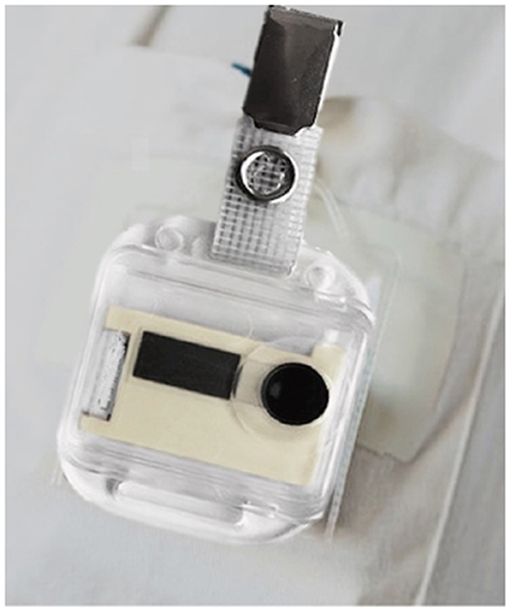
- Figure 3 - A dosimeter attached to the pocket of a healthcare professional’s lab coat.
- These devices are used in environments with ionizing radiation, such as vascular surgery or radiology departments, to monitor workers’ radiation exposure.
Setting Safety Limits
Specialists set strict safety limits for how much radiation a person can be exposed to in a calendar year (from January to December). If someone gets close to that limit, they must reduce their exposure, for example, by spending less time around radiation.
Preventive Measures
Occupational medicine specialists can develop and recommend strategies to minimize ionizing radiation exposure, such as improving workplace safety protocols, providing protective equipment like shields or barriers, and using tools that help block radiation.
Health Surveillance
Occupational medicine doctors regularly check the health of workers who are around radiation, balancing workers’ health and their job tasks. They provide baseline data in case of accidental radiation exposure or in case a worker develops a work-related illness. They also identify workers who are at the greatest risk, for example due to individual health issues, and help to protect these workers. Health surveillance includes general check-ups, blood tests, and specific exams, such as eye or thyroid scans.
Training and Education
Occupational medicine doctors teach workers about radiation risks and how to stay safe. They help workers understand the best ways to protect themselves.
Safety First: What We Learned
Radiation might seem scary, but not all radiation is dangerous. Radiation protection is crucial for safeguarding the health of workers and the public. Since radiation is invisible but potentially harmful, it is important to use the right protective measures, especially in workplaces where exposure might happen. Occupational medicine doctors play a key role in this process, ensuring workers are monitored, educated about risks, and provided with the necessary protective equipment and medical tests.
By focusing on prevention, early detection, and safe working conditions, occupational medicine doctors help minimize radiation exposure. Together with medical physicists, they work to protect both workers and the public from long-term radiation effects. Their expertise is vital for creating healthy, safe workplaces and a safer society overall.
Glossary
Ionizing Radiation: ↑ A powerful kind of radiation that can change atoms and harm living cells. It is used in medicine and industry, so safety measures are very important.
Ionization: ↑ When an atom gains or loses an electron and becomes a charged particle called an ion. Ionizing radiation can cause electrons to be lost from atoms, potentially damaging cells.
Nondestructive Testing (NDT): ↑ A way to inspect materials for defects without causing damage. Used in industries like aviation to check parts—like airplane wings—for cracks or hidden flaws.
Sievert (Sv): ↑ A unit used to measure the health effects of ionizing radiation on the human body. One sievert corresponds to a very high dose of radiation; millisieverts (mSv) are used for smaller doses.
Occupational Medicine: ↑ A branch of medicine focused on the prevention, diagnosis, and management of work-related injuries and illnesses, including the protection of workers from occupational hazards such as ionizing radiation.
Dosimeters: ↑ Device used to measure the amount of radiation exposure a worker receives; often worn by workers in environments where ionizing radiation is present, such as hospitals or nuclear facilities.
Conflict of Interest
The authors declare that the research was conducted in the absence of any commercial or financial relationships that could be construed as a potential conflict of interest.
Acknowledgments
This article was born from the idea of introducing younger generations to the field of occupational medicine. Despite being one of the lesser-known medical disciplines, it plays a central role in the prevention and protection of the working population’s health. With this goal in mind, we decided to start by exploring ionizing radiation as the first occupational hazard to analyze, offering young readers of Frontiers for Young Minds a chance to discover its importance. We hope this article sparks curiosity and a deeper understanding of the critical role occupational medicine plays in safeguarding public health. The authors contributed equally voluntarily and received no funding from any institution to produce this scientific work.
AI Tool Statement
The author(s) declare that no Gen AI was used in the creation of this manuscript.
Any alternative text (alt text) provided alongside figures in this article has been generated by Frontiers with the support of artificial intelligence and reasonable efforts have been made to ensure accuracy, including review by the authors wherever possible. If you identify any issues, please contact us.
References
[1] ↑ IARC Working Group on the Evaluation of Carcinogenic Risks to Humans 2000. Ionizing Radiation, Part 1: X- and Gamma (γ)-Radiation, and Neutrons. Lyon (FR): International Agency for Research on Cancer (IARC Monographs on the Evaluation of Carcinogenic Risks to Humans, No. 75). Overall Introduction. Available online at: https://www.ncbi.nlm.nih.gov/books/NBK401323 (Accessed January 20, 2025).
[2] ↑ Santivasi, W. L., and Xia, F. 2014. Ionizing radiation-induced DNA damage, response, and repair. Antioxid. Redox Signal. 21:251–9. doi: 10.1089/ars.2013.5668
[3] ↑ European Union 2014. Council Directive 2013/59/Euratom on basic safety standards for protection against the dangers arising from exposure to ionising radiation and repealing Directives 89/618/Euratom, 90/641/Euratom. 96/29/Euratom, 97/43/Euratom and 2003/122/Euratom. O J EU L13 57:1–73. CELEX: 32013L0059. Available at: http://data.europa.eu/eli/dir/2013/59/oj (Accessed January 25, 2025).