Abstract
Language and communication are important aspects of everyday life. We use our words all the time, which makes learning language seem easy. But learning language is not easy for all children. For example, some children are late talkers. These children learn to talk later than their peers. In this article, we explain what it means to be a late talker, why there are differences between children when it comes to learning to talk, and what those differences are. Knowing more about late talkers will help us to understand why some late talkers struggle to catch up more than others. We also discuss ways we can help children who are late talkers.
What Causes Late Talking?
Learning to talk is one of the most important parts of growing up. Language helps us learn, play, make friends, and much more. But not everyone begins talking at the same age. But why do some kids start talking later than their friends? Most kids say their first word around their first birthday, and they start using short sentences by their second birthday. These sentences are usually only a couple of words, for example “bye-bye dog” or “more cheese”. But some kids are late talkers, which means they do not start speaking until much later. By their second birthday, late talkers usually say fewer than 50 words and do not use sentences yet [1].
There are multiple causes for late talking. However, many late talkers have certain things in common. For example, many late talkers are born early and underweight, have family members who also spoke late, and have fewer family resources [1]. Of course, not everyone with these backgrounds will be a late talker—these are just some of the most common things late talkers share. Boys are more often late talkers than girls but not all boys are late talkers, and some girls are late talkers, too.
What is Late Talking vs. Late Blooming?
Late talkers fall into two groups: late bloomers and long-term late talkers. Late bloomers are kids who start talking later than other kids, but catch up quickly once they start talking. By around age 5, their language skills are about the same as children who started talking earlier. Long-term late talkers are kids who also start talking later, but these kids continue to struggle with language for a long time. Figure 1 shows differences in the first years of talking.
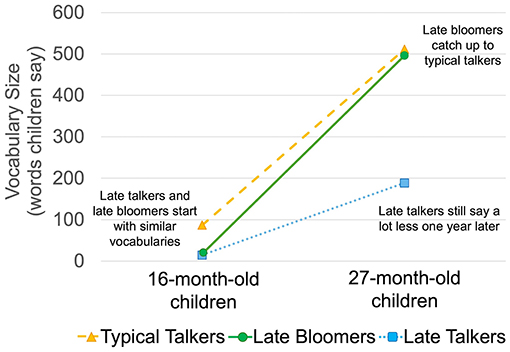
- Figure 1 - Vocabulary (spoken word) differences between typical talkers, late bloomers, and long-term late talkers from ages 1 to 2 years.
- At 16 months of age, we cannot yet tell who will be a late talker or late bloomer because kids’ vocabularies are the same at this age. However, at 27 months old, late bloomers and typical talkers are now similar and say a lot more than late talkers. This shows how late bloomers catch up with typical talkers in vocabulary, but late talkers do not [2].
There are differences between late talkers, late bloomers, and kids who talk on time—from before their first birthday all the way into adulthood. In childhood, a big difference is vocabulary: the words people say and understand. A group of psychologists studied the language skills of children from toddlers to teenagers [3]. Late talkers always had the smallest vocabularies throughout the 8 years. Late bloomers had slightly larger vocabularies. But kids who spoke earlier had the largest vocabularies throughout the study. Even as teenagers, late talkers had worse grammar, vocabulary, and verbal memory than their classmates. But they still did well on overall language and reading tests [4]. This shows us that these differences continue even as kids grow up.
Types of Vocabulary
Psychologists measure two kinds of vocabulary: receptive vocabulary and expressive vocabulary. Receptive vocabulary, which is sometimes called comprehension, is the words we understand. For example, you use your receptive vocabulary to read a book or to understand instructions. Expressive vocabulary, which is sometimes called language production, is the words you can use yourself. For example, you use your expressive vocabulary to share your thoughts or to ask questions.
This suggests that late talkers may struggle to talk because they cannot understand what others are saying. Struggling to understand others makes it harder to learn more words, leading to smaller vocabularies and poorer language skills.
Differences in Vocabulary
The number of words a child can say is not the only difference between late talkers and late bloomers. In fact, for toddlers there is not much difference in vocabulary size between late bloomers and late talkers (Figure 1). However, there is a difference in the types of words they know, particularly the types of nouns.
Most of the words toddlers say are nouns. Nouns are names for things like “pen” or “shoe”. Most of the nouns toddlers say are names for objects where shape is important because it helps people tell the object apart from other objects. For example, ball, dog, and spoon. These are shape-based nouns. Shape-based nouns support general word learning because they have strong links to many other words [2].
A few nouns are names for objects where the material and texture are important. For these nouns, their material makes them different from other things. For example, applesauce, jeans, or snowman. These are material-based nouns.
Finally, some nouns are names for things where both shape and material are important. For example, blanket and pizza. These are multidimensional nouns. Adults disagree on whether shape or material is most important for these nouns. For example, is it more important that a blanket is a rectangle or that it is made of fabric? Some multidimensional nouns can also have multiple shapes and materials. For example, pizza can come in many shapes and have many different textures. Multidimensional nouns are less helpful for learning what nouns have in common and they have fewer links to other words.
Late talkers, late bloomers, and kids who talk on time tend to learn different kinds of nouns (Figure 2). Late bloomers and typical talkers learn a lot of the same nouns. They know more shape-based nouns than other nouns. Knowing these nouns helps them learn even more words [2].
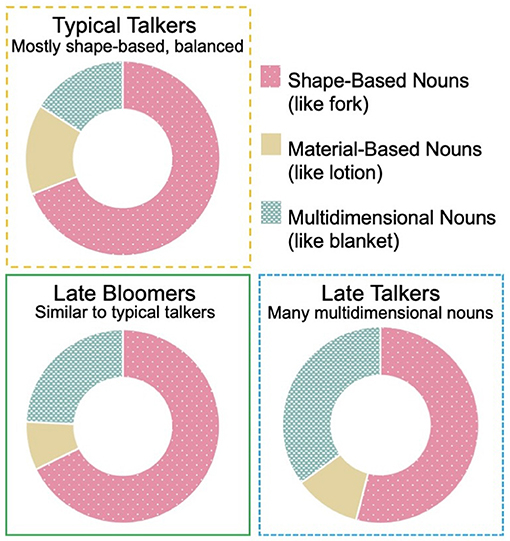
- Figure 2 - The types of nouns children know at 2 years of age.
- Typical talkers and late bloomers have balanced vocabularies with mainly shape-based nouns. Both of these groups will have typical vocabularies by 4 years. The two groups at the bottom are the two kinds of late talkers. The long-term late talkers know fewer shape-based nouns and a lot more multidimensional nouns [2].
However, late talkers learn nouns differently. They know fewer shape-based nouns than the other kids. They also learn more multidimensional nouns. But these are not the kinds of nouns that help kids learn new words. This could explain why late bloomers can catch up, but late talkers continue to struggle.
Can Late Talkers Communicate in Other Ways?
People can communicate without words. For example, we can use gestures and facial expressions (Figure 3). Gestures use body and hand movements. For example, waving hello, pointing, or giving a thumbs up to agree with someone are ways of communicating without using words. Facial expressions use the face and can also tell someone something without words—for example, smiling to show you are happy.
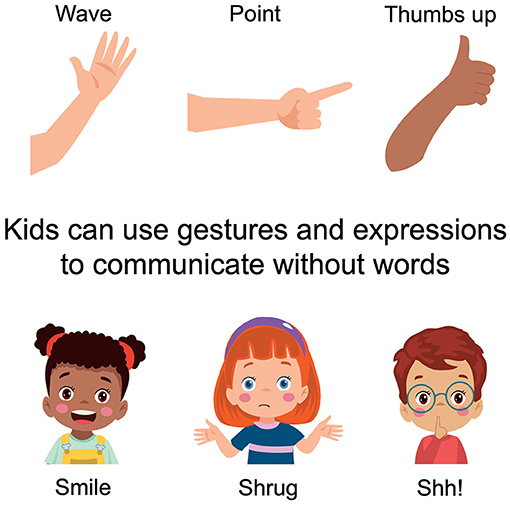
- Figure 3 - Six different gestures and facial expressions that are important during development, as they help us tell others something without using words.
- These gestures are so easy for babies to perform and allow them to interact and learn about the world around them. For example, pointing is one of the first gestures kids do, even before they can speak. This gesture allows babies to ask for something or show interest in something, which helps them learn language.
Late talkers and late bloomers also use gestures differently. As toddlers, late bloomers use more gestures than late talkers [5]. Late bloomers use at least as many gestures as typical talkers. In fact, late bloomers might use more gestures because they can use gestures if they struggle with “using their words”.
Late talkers use fewer gestures than both late bloomers and typical talkers. Their lack of gesturing shows that they may struggle with communication in general, not only with words.
What Can we do to Help?
Late talkers can face troubles throughout their lives. Many late talkers and late bloomers struggle with language, social skills, and controlling their emotions and behaviors. They also have difficulty planning, thinking, and paying attention. A good way to support late talkers is by helping them early, rather than waiting to see if they improve on their own [1].
We know the kinds of backgrounds that late talkers have in common. We also know that kids who use fewer gestures and know fewer shape-based nouns might be late talkers, too. So how can we help children who are or might be late talkers?
One of the best ways researchers have found to help late talkers is through their parents. For example, it is helpful when parents follow their child’s lead and respond to their interests. This can help expand the child’s vocabulary and give them confidence in communicating with others. Kids whose parents do this improve in vocabulary, sentence length, grammar, and communication [1]. This type of parent-guided communication can be used during everyday activities, social interactions, and daily routines. If you are a babysitter, you can do these things too!
Other activities that can help late talkers are playing together, reading storybooks to them, and asking questions. When playing, talk about what is going on, like “I threw the ball”, which helps kids learn words to match what they see. Reading storybooks helps kids learn words, especially when the same stories are read over and over. Encouraging kids to speak up is especially helpful. Instead of asking questions that can be answered with gestures like nodding, ask questions that encourage them to say something. For example, instead of “would you like milk?” ask “would you like milk or water?”.
It is important to remember that even though late talkers are struggling, they also want to talk. We should be patient and willing to wait for a response, just like being patient with someone who is struggling to learn to walk. Letting them talk at their own pace and being encouraging and supportive is the best thing we can do.
Parents who are worried about their child’s language skills should discuss their concerns with a professional. This is something that nurseries, preschools, doctors, and other professionals should also be looking out for, to make sure everyone can get the help they might need.
Glossary
Late Bloomers: ↑ Children who eventually catch up in language skills after starting to talk later than most children.
Long-term Late Talkers: ↑ Children who have long-term language difficulties and start talking later than most children. These children often have other difficulties as well.
Receptive Vocabulary: ↑ The words you understand. These words can either be spoken or written. You are using your receptive vocabulary to read this article!
Expressive Vocabulary: ↑ The words you speak to express your thoughts. These words could either be spoken or written. You might use your expressive vocabulary to talk about this article.
Shape-based Nouns: ↑ Nouns for which shape is very important. For example, spoons have the same shape but can be made from different materials. Most nouns are shape-based nouns.
Material-based Nouns: ↑ Nouns for which material is very important. For example, material is what makes jeans different from other trousers and therefore how we know they are jeans.
Multidimensional Nouns: ↑ Nouns for which multiple features are important. For example, both shape and material make a blanket a blanket, and adults do not agree on which feature is most important.
Conflict of Interest
The authors declare that the research was conducted in the absence of any commercial or financial relationships that could be construed as a potential conflict of interest.
AI Tool Statement
The author(s) declare that no Gen AI was used in the creation of this manuscript.
Any alternative text (alt text) provided alongside figures in this article has been generated by Frontiers with the support of artificial intelligence and reasonable efforts have been made to ensure accuracy, including review by the authors wherever possible. If you identify any issues, please contact us.
References
[1] ↑ Capone Singleton, N. 2018. Late talkers: why wait and see is outdated. Pediatr. Clin. North Am. 65:13–29. doi: 10.1016/j.pcl.2017.08.018
[2] ↑ Perry, L. K., Kucker, S. C., Horst, J. S., and Samuelson, L. K. 2023. Late bloomer or language disorder? Differences in toddler vocabulary composition associated with long-term language outcomes. Dev. Sci. 26:1–16. doi: 10.1111/desc.13342
[3] ↑ Armstrong, E. S. 2006. School-Age Cognitive and Achievement Outcomes for Late Talkers and Late Bloomers: Do Late Bloomers Really Bloom? [PhD Thesis]. University of Texas at Dallas, Dallas, TX.
[4] ↑ Rescorla, L. 2009. Age 17 language and reading outcomes in late-talking toddlers: support for a dimensional perspective on language delay. JSLHR. 52:16–30. doi: 10.1044/1092-4388(2008/07-0171)
[5] ↑ Thal, D., Tobias, S., and Morrison, D. 1991. Language and gesture in late talkers. J. Speech Hear. Res. 34:604–12. doi: 10.1044/jshr.3403.604