Abstract
In the fascinating universe of microbes, viruses known as bacteriophages (or simply phages) reside. These microscopic superheroes specialize in hunting bacteria. Unlike other viruses that make people sick, phages exclusively target harmful bacteria. Not only do they eliminate them, but within minutes, they replicate by creating armies of identical clones. In this article, we explore how the bacteriophage called T4 is constructed, a revolutionary ally in the fight against antibiotic-resistant infections. Discover why this tiny warrior could hold the key to defeating diseases that threaten human health!
What are Bacteriophages Used For?
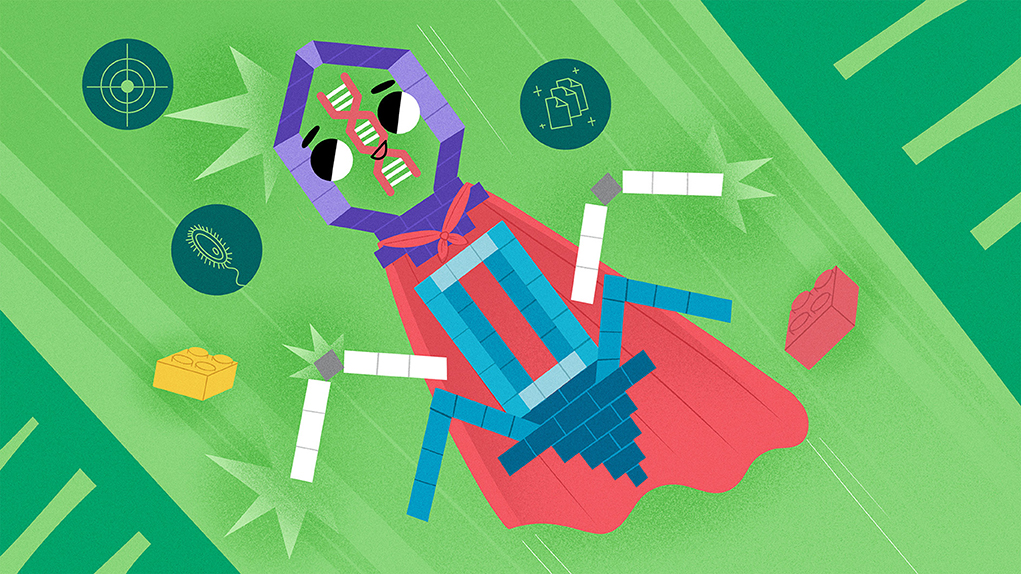
Bacteriophages are viruses that exclusively infect and destroy bacteria. For decades, they have been allies to scientists fighting antibiotic-resistant bacteria, which are bacteria that are no longer killed by the medicines doctors usually use to fight them. The story of bacteriophages begins in 1915, when Frederick Twort, while culturing bacteria in his laboratory, noticed mysterious “glassy spots” that destroyed bacterial colonies—but he could not identify their origin. Two years later, Félix d’Herelle, studying French soldiers suffering from severe diarrhea, discovered an “invisible microbe” that specifically destroyed the bacteria causing the illness. He named them bacteriophages (bacteria-eaters), demonstrating that they work like specialized hunters that attack only one type of bacteria. This pioneering work launched the modern use of phages in medicine and agriculture, where they act as microscopic superheroes against resistant bacteria (Figure 1) [1].

- Figure 1 - Bacteriophages, or simply phages, are viruses made up of a head, a tail, and tail fibers.
- They are useful in many areas: in agriculture, they help control bacterial diseases in crops; in the food industry, they are used to disinfect products and keep them fresh for longer; and in livestock farming and even in human health, they offer an alternative for treating bacterial infections.
For example, in the food industry, phages like the one called P100 eliminate harmful bacteria in meat and dairy products, extending the products’ shelf lives and ensuring fresher, safer food. Phages are also used to control bacterial pests in agricultural crops. Imagine a tomato field infected by bacteria that ruin the harvest: phages like M5 and M8 act as natural pesticides, targeting only harmful bacteria without damaging soil or plants, thereby increasing the production of toxin-free food.
Additionally, phages called T-even phages, such as T2, T4, and T6, treat infections in humans and animals caused by multiple kinds of bacteria. For instance, if a person with a urinary tract infection does not improve despite antibiotic treatment, phages can destroy harmful bacteria without affecting beneficial ones. This positions bacteriophages as a revolutionary tool for human and animal health [2]. Determining the exact number of types of T-even phages is challenging, as scientists continue to discover new types and occasionally update their names as their understanding advances.
How Does The T4 Phage Attack?
The T4 phage destroys bacteria in just 30 min, and it does so in four main steps (Figure 2) [3]:
• Step 1: Attachment—Lock-On Target! The T4′s long fibers act like a high-precision radar. They scan the bacterium’s surface until they find specific molecules that are only present on harmful bacteria. Once detected, they grip tightly. Target locked!
• Step 2: Penetration—Lethal Injection. The tail activates like a cannon. A sharp needle pierces the bacterium’s wall and injects the phage’s DNA. Bullseye!
• Step 3: Assembly—Factory Takeover. The phage’s DNA hijacks the bacterium’s machinery, turning it into a clone factory. In about 30 min, it produces the key parts of the T4 phage (head, tail, and fibers) to create 100–200 new phages. Assembly line complete!
• Step 4: Release—Cell Explosion. New phages use enzymes (molecular scissors) to dissolve the bacterium’s wall. The cell bursts open, releasing the phage army to hunt more bacteria. Mission accomplished!

- Figure 2 - Bacteriophage T4 cycle.
- (A) The phage uses its long fibers to recognize and stick to the bacterium. Each phage has different tail fiber tips. To recognize the bacterium, its tips must have the correct composition (1), otherwise the phage cannot recognize the bacterium (2). (B) The phage’s needle pokes the bacterium and injects its viral DNA. (C) The cellular machinery within the bacterium produces the parts for new bacteriophages and assembles them. (D) The new bacteriophages break the bacterium open and are released, so they can infect and destroy more bacteria.
T4 Construction Manual
Now that you know how the T4 phage destroys bacteria in just 30 min, it is time to learn how this superhero is built from scratch! The T4 phage has three key parts: a head, a tail, and long fibers. It is built inside a bacterium, using proteins as building blocks and special tools to assemble each piece. Every part develops separately but all three parts forms at the same time inside the bacterial cell. Keep Figure 3 handy while reading this section. It is your map showing how the T4 phage is assembled, from the head to the fibers. Without it, you would be trying to solve a puzzle without seeing the full picture.

- Figure 3 - The nine steps of building a T4 phage can be divided into four major areas.
- (A) First, the steps of head assembly take place on the internal membrane of the bacterium. (B) Then, the steps of tail assembly take place in the cytoplasm of the bacterium. (C) Assembly of the long fibers also takes place in the bacterial cytoplasm. (D) After all the pieces are made, the final assembly of the phage takes place in the cytoplasm of the bacterium.
Head: the “mothership”—protecting the DNA
• Step 1: create a protein bubble (pre-head) that forms around a “special door” (portal) located on the inner membrane of the bacteria.
• Step 2: the bubble breaks away from the inner membrane so that a “packaging machine” can fill it with phage DNA.
• Step 3: seal the portal to protect the viral DNA. The head travels to the cytoplasm [4].
Tail: the assault cannon that injects DNA
• Step 4: on the baseplate, there is a hexagonal tube (like a tunnel that shoots DNA into bacteria), short fibers (to grip the bacteria better), and a sharp needle (to poke a hole in them).
• Step 5: add a retractable sheath that contracts during infection to inject DNA into the bacteria and propel the needle forward.
• Step 6: install connectors to attach the head [5].
Legs: the long fibers that hunt bacteria
• Step 7: create long fibers with flexible joints.
• Step 8: add the correct configuration that recognizes specific bacteria.
Final assembly
• Step 9: connect the head, tail, and fibers to create the complete T4 phage [6].
Voilà! The T4 phage is battle-ready! Its head shields the DNA, its tail drills into bacteria, and its legs grip targets like a pro.
Why Study the T4 Phage?
Understanding how the T4 phage is assembled helps scientists design creative therapies to fight antibiotic-resistant bacteria. For example, if we know how the phage pierces and destroys Escherichia coli, a common type of bacteria, we could use it to treat urinary tract infections, intestinal infections, or other diseases that are currently hard to combat due to antibiotic resistance.
Why is the T4 an Invisible Hero?
Despite their potential, it is important to keep in mind that bacteriophages have some challenges and limitations that scientists still need to address. For example, we need to know which type of bacteria is causing the infection and which phage to use to fight it. Each phage only kills one type of bacteria, so we need different types together to treat infections with multiple bacteria. Also, bacteria can change their surfaces so phages do not recognize them and cannot destroy them. Phages also do not work well in environments with too much salt or sugar, such as salt-preserved foods (like pickles or salted fish) or very sugary foods (like syrups or jams). Too much salt or sugar makes it hard for phages to survive because it damages their bodies and stops them from attacking bacteria. Finally, before using them on people, we must do many tests to make sure phages are safe and ensure that any dangerous substances are removed.
In short, the T4 bacteriophage is an amazing example of how nature creates precise solutions. Although it is microscopic, its ability to replicate and eliminate harmful bacteria makes it a promising ally in the fight against future diseases. In a world where antibiotic resistant bacteria threaten to make a comeback, this tiny, microscopic superhero could inspire revolutionary solutions. The next time you hear about antibiotic-resistant “superbugs”, remember the little T4—silent, efficient, and ready to save the day!
Glossary
Bacteriophages: ↑ A virus that infects and destroys bacteria, acting like a tiny bacteria hunter.
Antibiotic-Resistant Bacteria: ↑ Bacteria that no longer die when treated with antibiotics, making infections harder to cure.
DNA (Deoxyribonucleic Acid): ↑ The genetic code that tells living things how to grow, function, and reproduce.
Enzymes: ↑ Special proteins that speed up chemical reactions, like tiny scissors or machines inside cells.
Cytoplasm: ↑ The jelly-like substance inside cells where many important activities happen.
Conflict of Interest
The authors declare that the research was conducted in the absence of any commercial or financial relationships that could be construed as a potential conflict of interest.
AI Tool Statement
The author(s) declare that no Gen AI was used in the creation of this manuscript.
Any alternative text (alt text) provided alongside figures in this article has been generated by Frontiers with the support of artificial intelligence and reasonable efforts have been made to ensure accuracy, including review by the authors wherever possible. If you identify any issues, please contact us.
References
[1] ↑ Talavera-González, J. M., and Talavera-Rojas, M. 2021. Bacteriófagos, los virus come-bacterias: historia de dos mentes científicas. RDU 22:5. doi: 10.22201/cuaieed.16076079e.2021.22.5.9
[2] ↑ Cui, L., Kiga, K., Kondabagil, K., and Wegrzyn, A. 2024. Current and future directions in bacteriophage research for developing therapeutic innovations. Sci. Rep. 14:24404. doi: 10.1038/s41598-024-76427-5
[3] ↑ Karczewska, M., Strzelecki, P., Szalewska-Palasz, A., and Nowicki, D. 2023. How to tackle bacteriophages: the review of approaches with mechanistic insight. Int. J. Mol. Sci. 24:4447. doi: 10.3390/ijms24054447
[4] ↑ Rao, V. B., Fokine, A., Fang, Q., and Shao, Q. 2023. Bacteriophage T4 head: structure, assembly and genome packaging. Viruses 15:527. doi: 10.3390/v15020527.
[5] ↑ Arizaka, F., Yap, M. L., Kanamaru, S., and Rossmann, M. G. 2016. Molecular assembly and structure of the bacteriophage T4 tail. Biophys. Rev. 4:385–96. doi: 10.1007/s12551-016-0230-x
[6] ↑ Hyman, P., and van Raaij, M. 2018. Bacteriophage T4 long tail fiber domains. Byophys. Rev. 10:463–71. doi: 10.1007/s12551-017-0348-5